Short-term rentals enter a new phase of scrutiny and structural growth
- Published:
- August 2026
- Analyst:
- Phocuswright Research


Following the post-pandemic boom years, the global short-term rental (STR) market has settled into a period of structural realignment. According to Phocuswright’s Global Short-Term Rentals 2026, gross bookings reached US$219.9 billion in 2025 and are projected to grow at a 5.3% compound annual rate through 2029, reaching $270.6 billion.
Three themes anchor the 2026 outlook: The sector has shifted from a period of unregulated growth to one of enforcement and scrutiny, reshaping supply across key markets. Technology and platform shifts, including generative AI and evolving business strategies such as Airbnb's expansion beyond stays, are transforming how travelers discover and book trips, though their impact on incremental STR demand remains unclear. And on the demand side, evolving consumer expectations around trust, consistency and value are contributing to a rebalancing between short-term rentals and hotels.
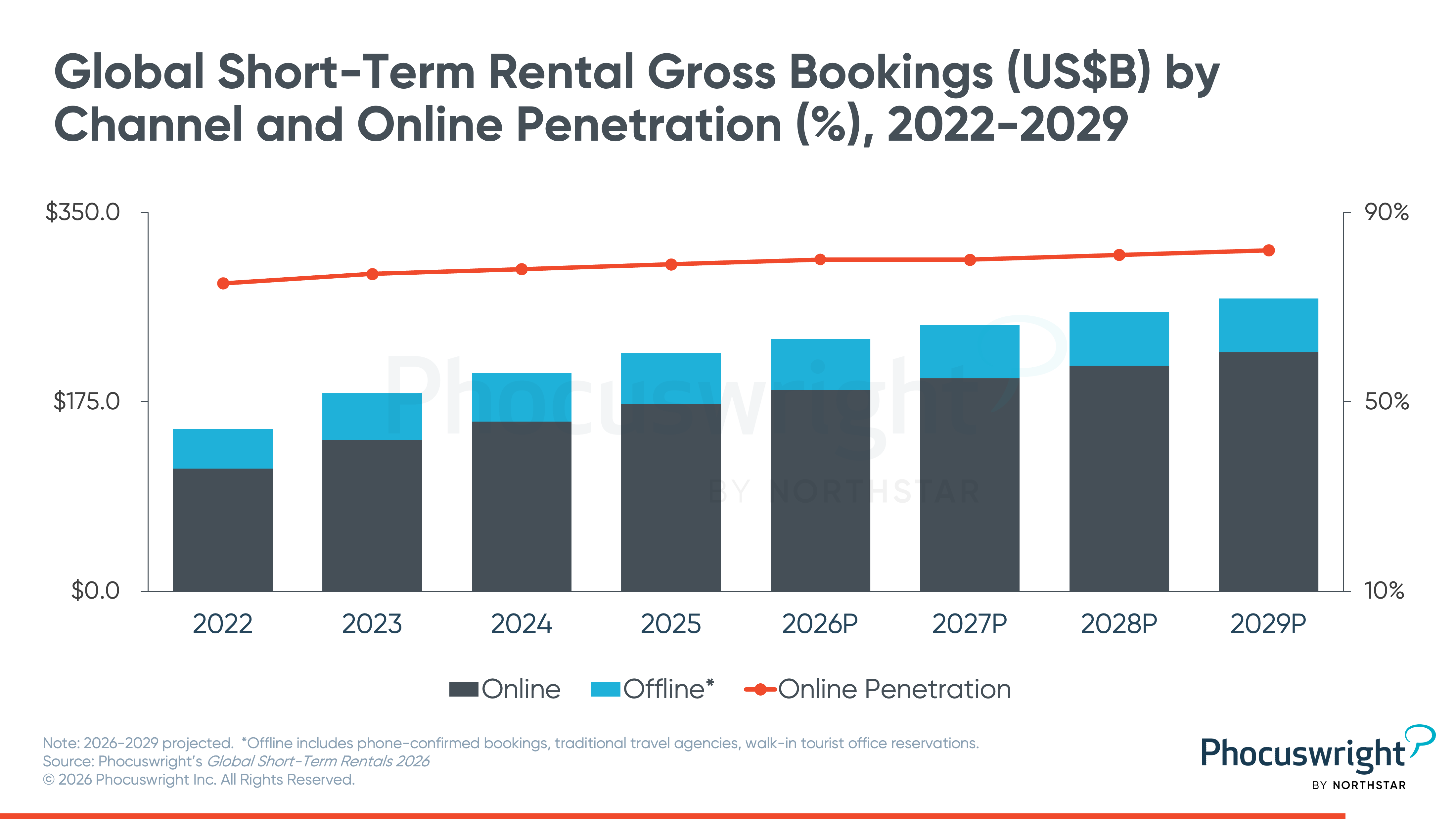
Underpinning all three, demand fundamentals remain strong. North America STR gross bookings grew 4% in 2025 to $78 billion and are projected at 5% growth in 2026 to reach $81.8 billion, outpacing U.S. hotels, which expanded a more modest 1% in 2025 and are forecast to grow 3% in 2026.
U.S. STR usage incidence—the share of leisure travelers who used a short-term rental on their most recent trip—leaped from 24% in 2023/24 to 30% in 2024/25, the largest single-period increase in the series and the first time since 2019 the figure has cleared 28%. Partial explanations for the jump include trip lengths in the U.S. stretching from 6.2 nights in 2022/23 to 7.2 in 2024/25, and 14-night-and-longer trips climbing from 16% to 21% where STRs better compete. At the same time, comparison between hotels and STRs is becoming more common, signaling the category's deeper integration into traveler decision-making.
By contrast, STR usage in several European markets is higher or on par with the U.S., such as in France (44%), the UK (31%) and Germany (26%). Rather than reflecting a recent spike, these figures point to a more established, structural role for short‑term rentals in European leisure travel. Europe will reach $79.7 billion in gross STR bookings in 2026.
Beyond the two largest regions, the growth story diverges in shape rather than direction. Asia Pacific continues to benefit from a post-pandemic recovery trajectory that has extended further than in other regions, supporting strong STR growth through the forecast period. With recovery runway still remaining, APAC is projected to grow at an 8.9% CAGR through 2029, reaching $49.3 billion.
Latin America posted the strongest regional growth in 2025, on the back of robust travel demand and strengthening booking activity in key markets such as Brazil, alongside shifting North American travel flows toward Mexico.
The Middle East & Africa remains the smallest region and sees its 2026 growth interrupted by continued regional conflict. Gross bookings will reach $10.3 billion by 2029.
Methodology
Phocuswright's Global Short-Term Rentals 2026 sizes the global STR market by region and distribution channel. Market size is expressed as total gross bookings, the transaction value (net of refunds and cancellations) of all STR stays booked through intermediaries, hosts and professional property managers.
Phocuswright defines short-term rentals as non-hotel/hostel lodging rented by travelers for less than 30 days, and reasonable effort is made to remove hotel, tour and other non-STR revenue from gross bookings estimates. Phocuswright derives findings primarily from desk research. This includes Airbnb, Booking Holdings and Expedia financial filings; third-party data and publications; market analyst interviews; and prior Phocuswright sizing. Regions covered: North America, Europe, Asia Pacific, Latin America and the Middle East & Africa. Per Phocuswright convention, Mexico is included in Latin America.
One methodological refinement distinguishes this edition of the report from prior years: Online penetration figures in Asia Pacific, Latin America and the Middle East & Africa have been revised to reflect a fuller view of the offline portion of those markets. Continued research into regional booking channels, such as phone-confirmed bookings on Tujia and Meituan, Brazilian and Mexican property manager direct relationships, traditional European agency systems and informal rentals across Africa and South Asia surfaced a larger offline segment than prior editions reflected.
Phocuswright’s Global Short-Term Rentals 2026 presents market sizing and forecasts for the global STR market by region and distribution channel. Key questions answered by this research include:
- How is the global short-term rental market evolving as it moves from lightly regulated expansion to stricter enforcement and structural adjustment?
- How do growth trajectories differ across North America, Europe, Asia Pacific, Latin America and the Middle East and Africa?
- What role will online distribution, supplier-direct channels and major platforms play in the future of STR bookings?
- How are regulation, platform strategy and AI reshaping visibility, operations and competition across the STR sector?
- How are traveler expectations around trust, consistency and value influencing the balance between short-term rentals and hotels?
Looking for more insights? Phocuswright Open Access subscribers get the full library of research on every major travel sector, including market sizing, consumer behavior studies and operator surveys across air, hotel, short-term rental, experiences and more.
Subscribers also get direct access to the Phocuswright AI research assistant, built to answer questions across the entire research library in seconds rather than searching report by report. Ask it to compare markets, pull specific data points or surface findings across years of research, all grounded in Phocuswright's own reports. Learn more about leveraging the research assistant.
Subscribe to Open Access to get the full report library and the AI research assistant in one plan.
More Research Insights