India's travel market stalls in 2025, then bets on a fare-driven rebound
- Published:
- September 2026
- Analyst:
- Phocuswright Research
India's travel market grew 1% to US$41.7 billion in 2025, according to Phocuswright's India Travel Market Essentials 2026. The slowdown was abrupt after 10% growth in 2024.
Segment performance split sharply. Air was the weakest segment, weighed down by operational disruptions at market leaders IndiGo and Air India. Car rental grew fastest as uncertainty pushed more travelers toward road trips.
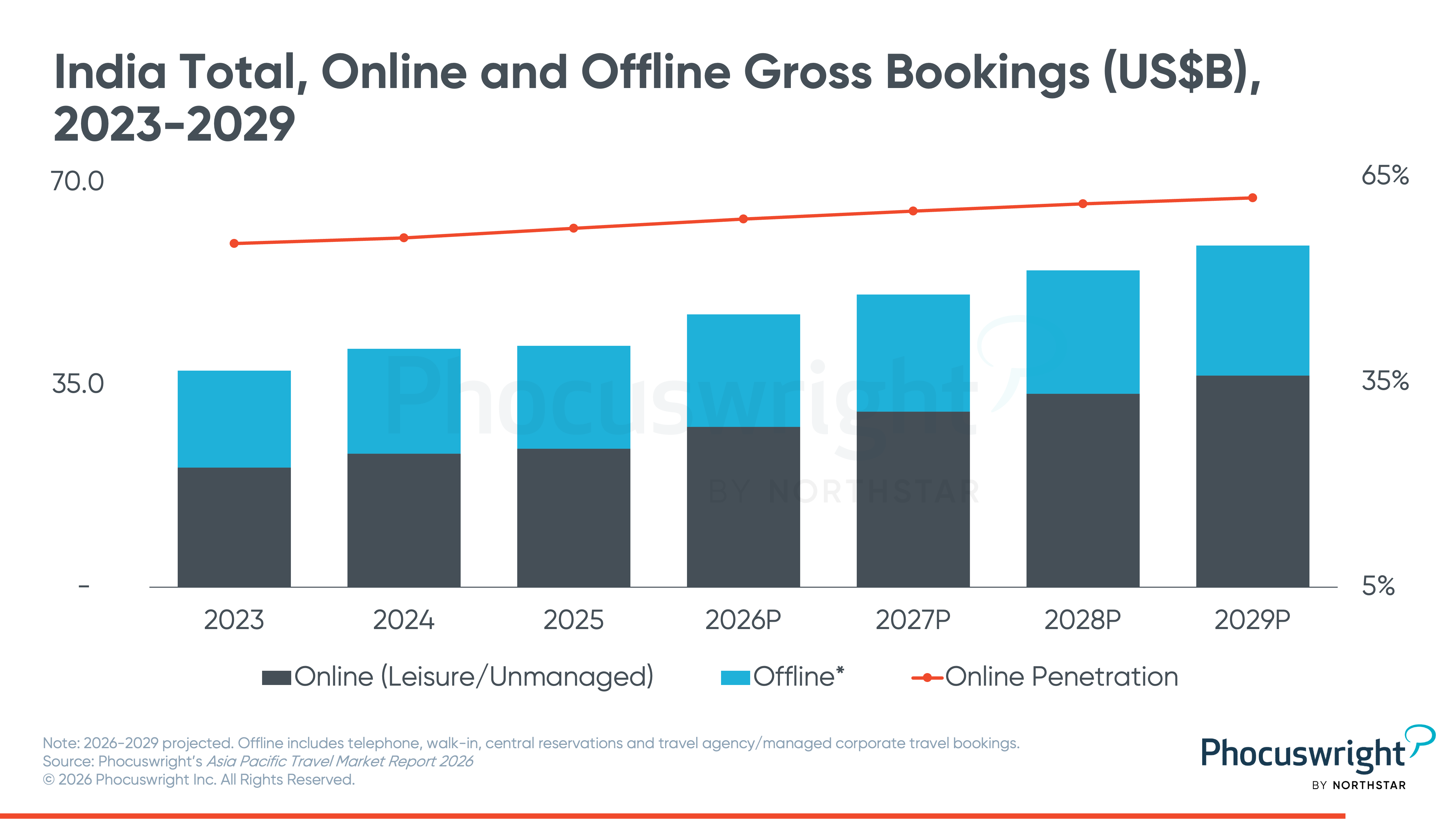
The flat total also hides a channel shift. Online gross bookings rose 4% to $24.0 billion while offline bookings fell 2% to $17.8 billion. Online penetration reached 57%.
A rebound built partly on price
Phocuswright projects 13% growth in 2026, lifting the market to $47.2 billion. Higher airfares account for part of the increase. Resilient domestic travel should sustain demand for accommodation and car rental, and geopolitical uncertainty continues to steer travelers toward domestic destinations.
Growth then moderates to 7% in 2027 before settling around 8% annually, reaching $59.1 billion in 2029. Online penetration climbs to 62% over the same period.
Airlines absorb a fuel shock
Jet fuel became one of Indian aviation's biggest problems in 2026. Carriers introduced fuel surcharges and raised fares, but India's price-sensitive travelers limit how much cost airlines can pass through. On shorter domestic routes, rail and road remain real alternatives.
The pressure is severe enough that the government committed up to ₹10,000 crore in price-stabilization support for aviation turbine fuel.
Costs are now reshaping networks. Air India trimmed parts of its international network. IndiGo will end its leased widebody experiment in October as fuel costs, longer routings and currency pressure erode the economics of international flying.
The damage shows in earnings. IndiGo posted profits in FY24 and FY25, then recorded a ₹2,394 crore net loss in FY26. It remained unprofitable in the first quarter of FY27 despite substantially higher passenger revenue. Several other Indian carriers were already losing money before the cost surge.
Both leading airlines face these conditions under new leadership. Former IAG CEO Willie Walsh took charge of IndiGo in August with a mandate to strengthen operations and expand internationally. Air India appointed former Ethiopian Airlines CEO Tewolde Gebremariam to lead its turnaround, with a focus on reliability, safety, hub development and profitable growth. Each must expand fleet and network without losing financial and operational discipline.
Phocuswright expects the airline sector to grow 16% in 2026, partly on higher fares. Growth then slows in 2027 before recovering in both 2028 and 2029.
Platforms and suppliers compete for the whole trip
India's online travel agencies (OTAs) are moving into every part of the journey they do not yet serve. MakeMyTrip acquired a majority stake in group-tour specialist Flamingo Transworld in March 2026 and is expanding into tours and attractions. ixigo's Brevistay deal gives the transport-led platform a foothold in short-duration hotel stays. Cleartrip entered rail in 2026, adding it to flights, hotels and buses. EaseMyTrip built its EMT 2.0 strategy around higher-margin hospitality, holidays and mobility.
Suppliers are pushing in from the other side. Air India sells Booking.com stays through its own channels and awards Maharaja Club points on them. IndiGo sells hotels and links its loyalty currency with Accor's. Indian Railway Catering and Tourism Corporation (IRCTC) packages complete overseas holidays, and Radisson Flights lets a hotel company sell the flight along with the stay.
Companies that stay in their traditional lane risk ceding the next transaction, and possibly the customer, to a competitor.
AI moves into the transaction
Startups including 30 Sundays, The Tarzan Way, Rimigo and Scapia are using AI to simplify holiday planning. They target itinerary building, experience curation and end-to-end trip management. Several raised venture funding in 2025 and 2026.
Incumbents are responding. MakeMyTrip's Myra 2.0 handles search, comparison, booking and payment in one conversational flow. ixigo rebuilt its core app around TARA, an AI agent that can plan, book and act for travelers across the trip. Air India's AI.g covers planning, booking support and servicing. India-based RateGain is building AI into hotel marketing, distribution and revenue optimization, reinforced by its acquisition of Sojern.
The next contest is over which company converts a traveler's intent into a completed, managed journey fastest.
India Travel Market Essentials 2026 is part of Phocuswright's Asia Pacific Travel Market Report 2026 series. One purchase unlocks the full series, including market reports on China, Japan, Australia-New Zealand, Northeast Asia and Southeast Asia.
Open Access subscribers get India Travel Market Essentials 2026 at no cost, along with company-wide access to Phocuswright's full research library and data visualization tools. Learn more about Open Access.
More Research Insights