China's OTAs face a reckoning as growth slows and regulators circle
- Published:
- September 2026
- Analyst:
- Phocuswright Research


China's travel market continues its steady climb, expanding at a moderate pace in 2025 as deflationary pressure across the consumer economy tempers headline growth without denting underlying supply or demand. Online penetration keeps advancing too, propelled by mobile adoption in lower-tier cities and by OTA and supplier efforts to lock in app loyalty and booking conversion. That distribution shift is entering a new phase as AI-enabled e-commerce reshapes how travelers search, compare and book, a transition that will test which platforms can hold their ground. Nowhere is that test sharper than among the OTAs themselves, where a decade of consolidated market power now meets slowing growth, regulatory scrutiny and margin pressure at once.
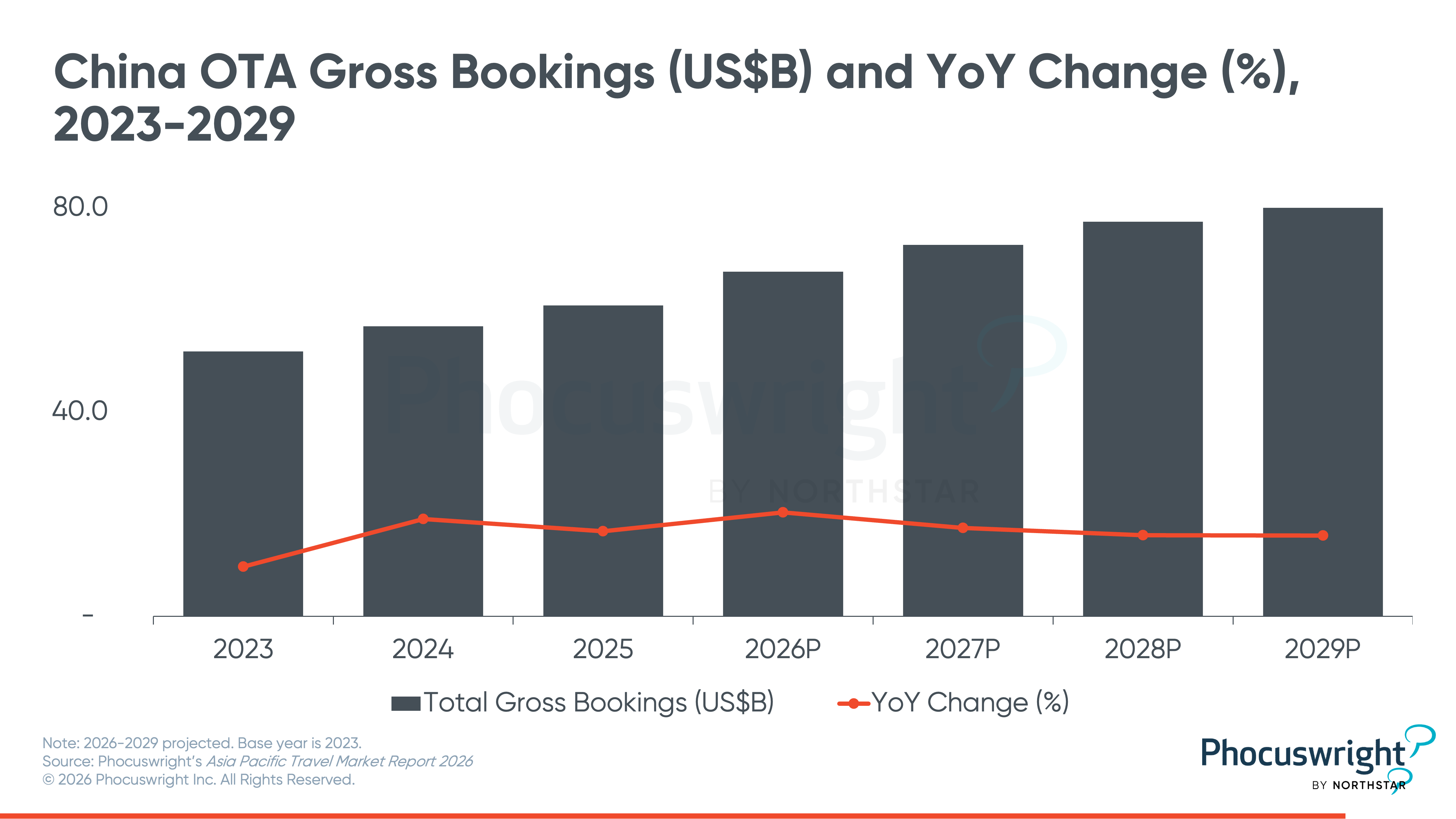
Over the past decade, China's OTAs have built market power that enabled them to weather the pandemic's crushing of travel supply and demand and bounce back aggressively. Gross revenue of $60.9 billion in 2025 can be seen as a stepping stone along a projected growth trajectory from $51.9 billion in 2023 (the first year of China's post-COVID reopening) to $82.2 billion in 2029. But the Chinese economy continues to evolve and the OTA landscape is beginning to look over-supplied. A clutch of large players is battling for customers across differentiated segments in a market where the explosive growth of the pre-COVID years is moderating and profit forecasts are weakening.
Given the sticky deflationary pressures across China's economy, the government is determined to stamp out neijuan or involution (zero-sum competition manifested through sustained price discounting for customers and unfair pressure on suppliers, also known in China as "rat-race competition"). The online travel sector is under close regulatory scrutiny, which resulted in the nation's first anti-monopoly case involving an OTA. In July 2026, after a six-month investigation, Trip.com, China's largest OTA, was fined an eye-watering RMB5.18 billion for violating China's Anti-Monopoly Law by deploying illegal pricing and traffic allocation practices and platform exclusivity restrictions in its agreements with hotel suppliers. Accommodation reservations form the largest share of Trip.com's annual revenue, accounting for 42% in 2025.
Widespread usage of AI trip-planning tools is making travelers better informed, more discerning and more assertive in terms of what they desire—and what they don't want—from each trip. As a result, booking windows are short and volatile, and travelers have a very clear idea of the value and service standards and quality they expect across the entire travel journey.
The agentic AI shock starting to ripple through Chinese online commerce will impact pure OTAs like Trip.com as well as those backed by monolithic cloud services conglomerates like Fliggy (Alibaba) and Tongcheng (Tencent), plus mobile mega-marketplaces like Meituan and JD.com. To stiffen its balance sheet backbone, Tongcheng, whose largest shareholders are Trip.com and Tencent, embarked on a cross-segment acquisition spree, adding Wanda Hotels & Resorts and potentially ride-hailing business Dida to its purchase of Hunan Airlines. Social travel commerce platforms like Douyin and Xiaohongshu provide alternative options that are aligned with travel but not reliant on it for revenue generation.
Get the full picture.
China Travel Market Essentials 2026 breaks down the data and trends shaping the world's largest travel market, from inbound tourism's national push to the agentic AI shift already reshaping distribution. Download the report for the full market sizing, segment analysis and forecasts through 2029.
One subscription. The entire research library.
A Phocuswright Open Access subscription unlocks the full China Travel Market Essentials 2026 report alongside Phocuswright's entire research library, plus the AI research assistant that lets subscribers query findings, pull data points and get sourced answers across the full catalog in seconds. Learn more about Open Access.
More Research Insights