Snow is optional: What moves winter sports travelers when the forecast fails
- Published:
- October 2026
- Analyst:
- Phocuswright Research


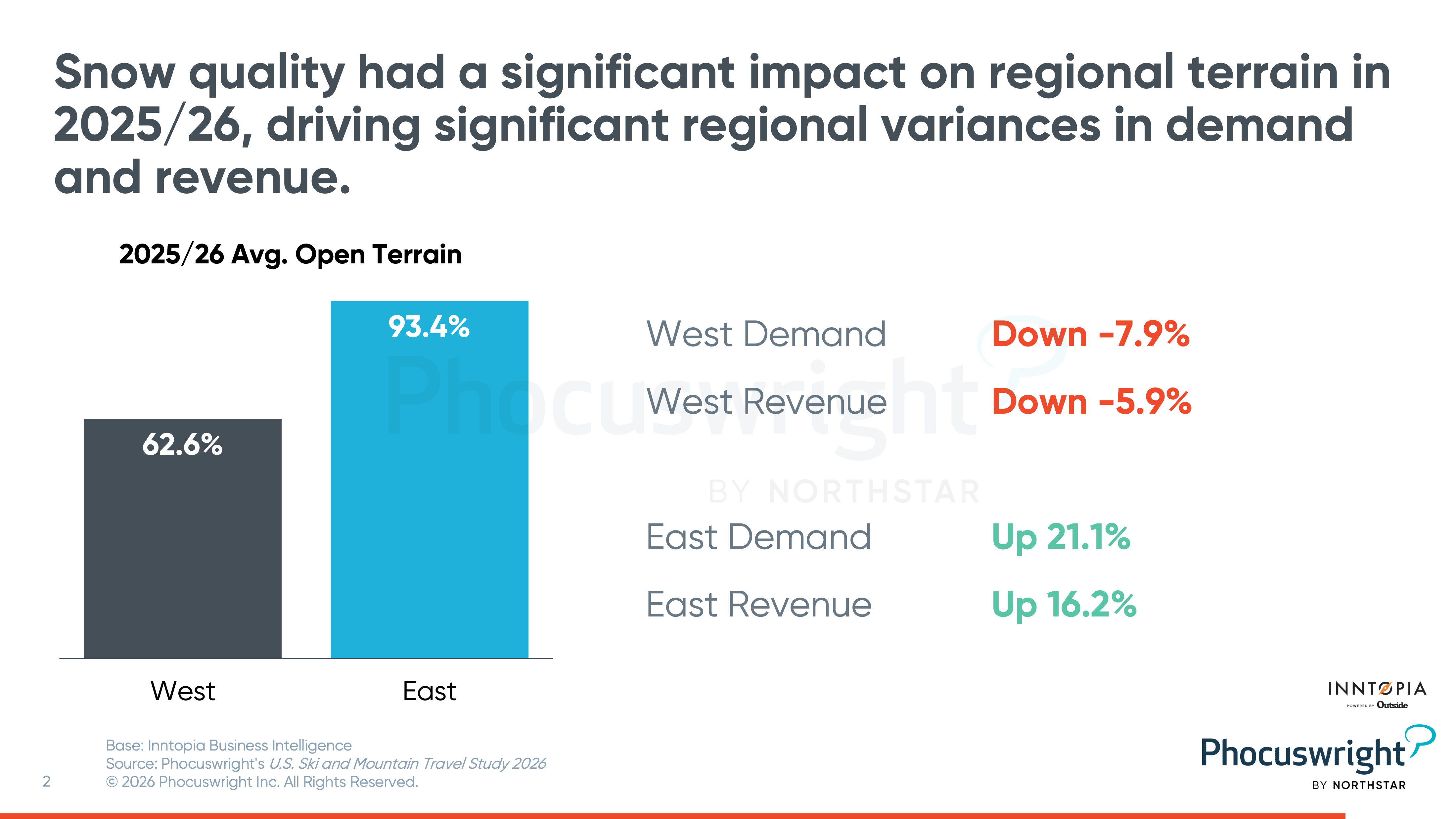
The 2025/26 ski season split the U.S. in two. Northeast resorts averaged 93.4% open terrain while the West managed just 62.6%, and demand followed the snow: Western demand and revenue fell as the East posted double-digit gains, according to Inntopia Business Intelligence data in Phocuswright's Mountain & Ski Travel 2026.
Operators cannot control snowfall, but they can control what makes a trip worth booking without it. Phocuswright's latest study maps who commits to a mountain trip when the forecast is uncertain and what it would take to win over the travelers who hesitate.
A high-value audience with a thin pipeline
Winter sports travelers spend at a different level than the broader market. Forty-five percent took a trip in the past 12 months costing US$1,500 or more per person per day, excluding airfare, compared with 15% of other leisure travelers. Luxury lodging captures much of that spend: over three years, luxury properties in mountain markets led on both average daily rate (ADR) and revenue per available room (RevPAR), while economy properties declined on both measures.
That value rests on a narrow base. Advanced and expert athletes make up the largest share of winter sports travelers and beginners the smallest, and the most committed customers may be stretching their budgets. Seventy percent of advanced athletes say they would take on debt to travel, compared with 34% of beginners.
The next generation is also drifting. Gen Z winter sports travelers took fewer trips in 2025 and early 2026 than in the three years before, even as Millennials and Gen X traveled more. For an industry already struggling to convert beginners, a cooling young audience compounds the problem.
Travelers split on risk
Aspiration still outweighs price. Most winter sports travelers would choose an expensive destination they have always wanted to visit over a cheaper one that excites them less, and advanced athletes lean even further that way.
Uncertainty is a different story. About half would book a ski trip last minute on a good snow forecast, while the rest would rather lock in a warm-weather trip far in advance. Insurance produces the same split: half would buy a policy to cancel or postpone a ski trip for bad weather, and half would book a nonrefundable beach trip instead. Refund products reassure some travelers but leave many unmoved, and beaches and theme parks remain in the running for the same winter budget.
Five personas for uncertain seasons
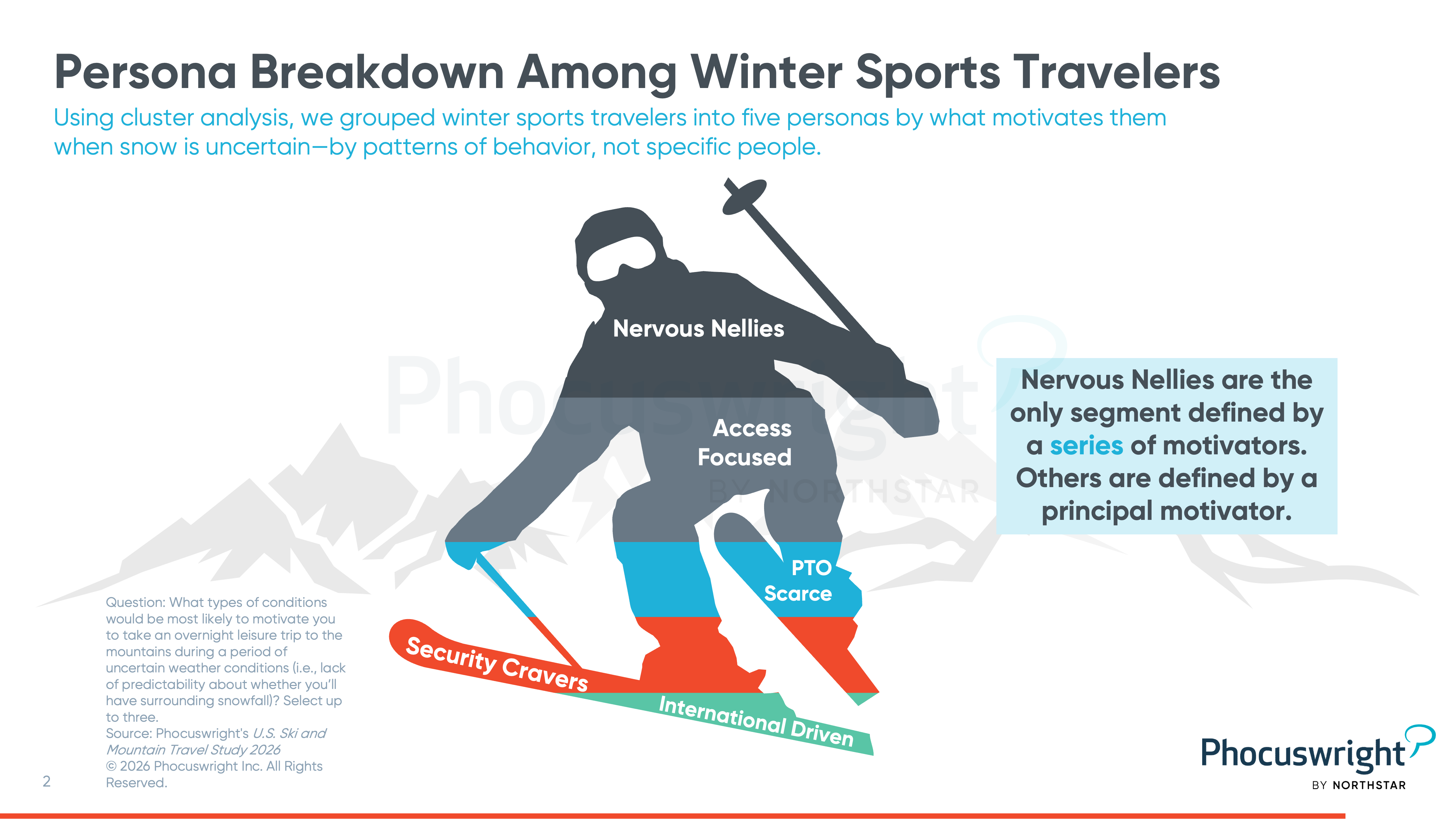
Phocuswright used cluster analysis to sort winter sports travelers by what would prompt them to book when snow is uncertain. The result is five distinct personas, each with a different barrier to overcome.
Nervous Nellies form the largest group and have no single trigger. They respond to a combination of fixes, led by flexible cancellation, better lodging prices and indoor activities, so no one lever converts them on its own.
Access Focused travelers see getting there as the main obstacle, whether that means better routes and flights or lower transportation costs. PTO Scarce travelers cannot risk limited vacation days on a weak forecast; nearly half of this group has 10 or fewer days of paid time off per year.
Security Cravers want insurance that partially or fully refunds bookings if snow fails, which makes them the easiest group to win with the right ancillary products. International Driven travelers fold skiing into broader trips abroad, part of a wider trend in which about a third of winter sports travelers took their most recent trip outside the U.S., led by Canada and Europe.
Selling winter without snow
The strongest case for a snowless mountain trip is the setting itself. Asked what makes winter mountain visits appealing, travelers chose natural beauty first and peace and quiet second, followed by physical activity, cozy experiences and the food and beverage scene.
These motivators give destinations a message that holds up regardless of the forecast. Lodging, dining and indoor activity providers stand to gain the most from putting them front and center.
What it means for the industry
The findings point to three priorities. Flexibility has to come bundled, because the largest persona wants flexible cancellation, better prices and alternative activities together, and insurance alone moves only a minority. Access is a demand problem as much as a logistics one, which puts airlines and destination marketers in the same conversation as resorts.
The pipeline needs attention, too. A customer base anchored by debt-tolerant experts and a cooling Gen Z audience is not a stable foundation. Destinations that sell the mountains on beauty and calm, and not only on snow, give themselves a wider funnel.
Get the full picture with Open Access
This article covers a fraction of the findings. The full report includes the complete persona profiles, motivator rankings by segment and the lodging performance data behind the season's regional split.
Phocuswright Open Access subscribers get every report in the library plus the AI chatbot research assistant, which answers plain-language questions with data drawn from Phocuswright's full body of research. Subscribers can pull the exact figure for a pitch, compare segments across reports or test an assumption before a planning meeting, all in seconds.
More Research Insights