The trust economy: How European travelers decide who to believe
- Published:
- September 2026
- Analyst:
- Phocuswright Research


European travelers are not turning away from new technology. They are getting pickier about who earns their trust, which institutions get their data and which digital tools belong in the travel journey. Phocuswright's latest consumer research report Europe’s Trust Economy: Confidence as Travel’s Newest Competitive Advantage shows trust operating as a filter at every stage of the funnel—from inspiration through booking to post-trip.
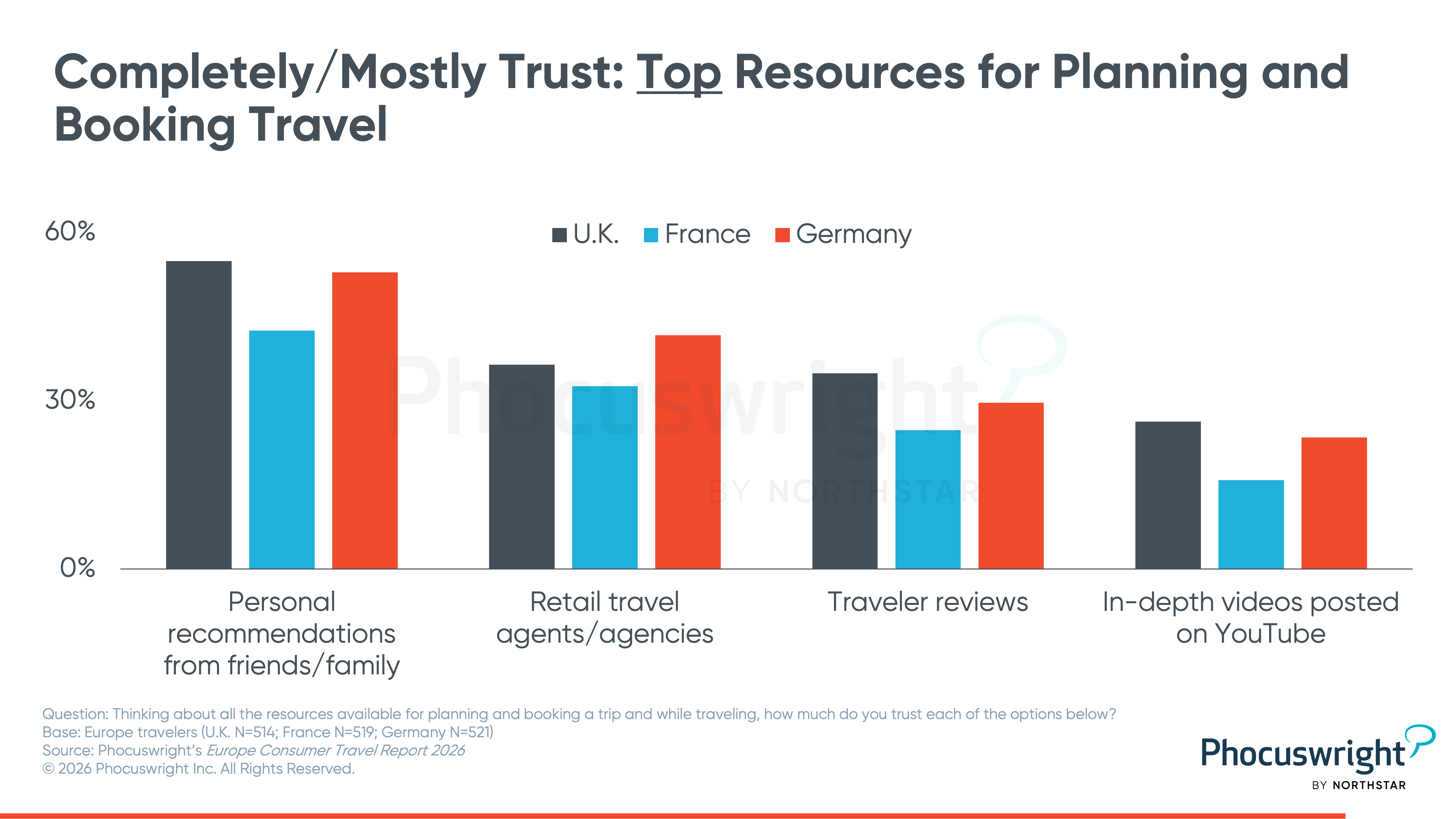
Human sources still win. Friends and family are the most trusted planning resource, with 42-55% of travelers saying they completely or mostly trust personal recommendations. Retail travel agents follow at 33-42%, ahead of most digital content sources. The advantage is not information volume: it is accountability. A recommendation from a known person or a professional advisor carries judgment that generic content or an algorithm has not yet earned.
Artificial intelligence tells a different story. Usage is climbing, but trust in AI-generated results holds at roughly 17-20% across planning environments. Travelers will use AI to generate ideas or narrow a shortlist, then verify that output against search, OTA listings, hotel sites, agents, reviews or friends. That gap between adoption and confidence is the headline finding for marketers: AI functions as an assistant, not an authority, and closing the gap requires transparency about why a recommendation surfaced, not just faster output.
Data sharing follows the same logic. Comfort rises when the benefit is concrete and immediate, such as faster check-in, easier checkout or smoother identity verification. Comfort drops as the use case shifts toward inferred personalization, especially when data moves across companies or gets built from browsing history without a clear reason.
Country differences complicate any pan-European strategy. U.K. travelers show more general openness. German travelers are more cautious. French travelers show more skepticism toward several information sources. A single trust message will not travel evenly across these three markets.
For marketers and travel executives, the implication is direct: trust has moved from brand attribute to product requirement. Winning in the next phase of travel technology will not come from adding personalization or automation. It will come from making digital experiences easier to verify, easier to control and easier to trust. It will also come from designing AI and data features that travelers can see the logic behind, not just the output.
This new research carveout explores how trust is becoming a defining force in European travel behavior and a growing competitive advantage for travel brands. Based on Phocuswright consumer research in the U.K., France and Germany, it examines how travelers evaluate planning sources, AI-generated recommendations, data-sharing requests and digital identity tools across the travel journey. The report shows that while European travelers remain open to new technology, adoption depends on transparency, control and clear consumer value. It also highlights important market-level differences, showing why trust strategies around AI, personalization and data use must be localized rather than one-size-fits-all. Start reading the full report here.
Get answers, not just reports.
Phocuswright Open Access includes a built-in AI research assistant that searches the full Phocuswright and PhocusWire library on demand. Subscribers can ask a direct question and get a synthesized answer in seconds, complete with citations back to the original report, figure and page.
The assistant covers market sizing and channel breakdowns, traveler behavior data, technology and AI adoption trends, and Phocuswright's interactive databases, including Phocal Point and the Travel Startups Database. Every answer is sourced, so findings can go straight into a deck or a board memo without a manual search through PDFs.
Start an Open Access subscription and put the research assistant to work. Contact us to learn more.
More Research Insights