AI isn’t just for research anymore: What European travelers are actually doing with it
- Published:
- August 2026
- Analyst:
- Phocuswright Research

New data from Phocuswright's Europe Consumer Travel Report 2026 shows AI has moved well past search and inspiration. Travelers in the U.K., France and Germany are now using it across nearly every stage of a trip, from the first idea to decisions made mid-destination.
The channels are already fragmented
Standalone AI platforms remain the top entry point in every market, led by Germany at 51%, France at 48% and the U.K. at 44%. U.K. travelers stand out for spreading their AI use across a noticeably wider set of environments than their French or German counterparts, reaching 33% for OTA and metasearch features and 29% for social platforms, roughly double the French and German shares. Search engine AI answers show a different leader entirely, with Germany at 34% ahead of the U.K. at 29% and France at 25%.
No single channel captures the full audience, and the mix shifts meaningfully by country. A strategy built around one AI surface risks missing a substantial share of travelers everywhere.
Planning tasks span far beyond simple research
Hotel research leads in the U.K. and Germany, both at 39%, while French travelers lean more toward activity research (33%) and destination comparison (29%). Flight research holds a fairly consistent share across all three countries. Cruise research is the clear laggard, and translation is the one task where Germany pulls ahead of its peers.
The range itself is the story: AI has become a tool travelers reach for across most of the planning journey, not just at the start.
In-destination use favors discovery over logistics
Real-time recommendations are the leading in-destination use case by a wide margin in every market, led by the U.K. at 53%. Tasks tied to trip management, handling disruptions, managing reservations, trail well behind, often 20 percentage points lower or more. Travelers appear to see AI more as a companion for discovery right now than as a tool for operational trip management.
Decisions are real, and vary sharply by market
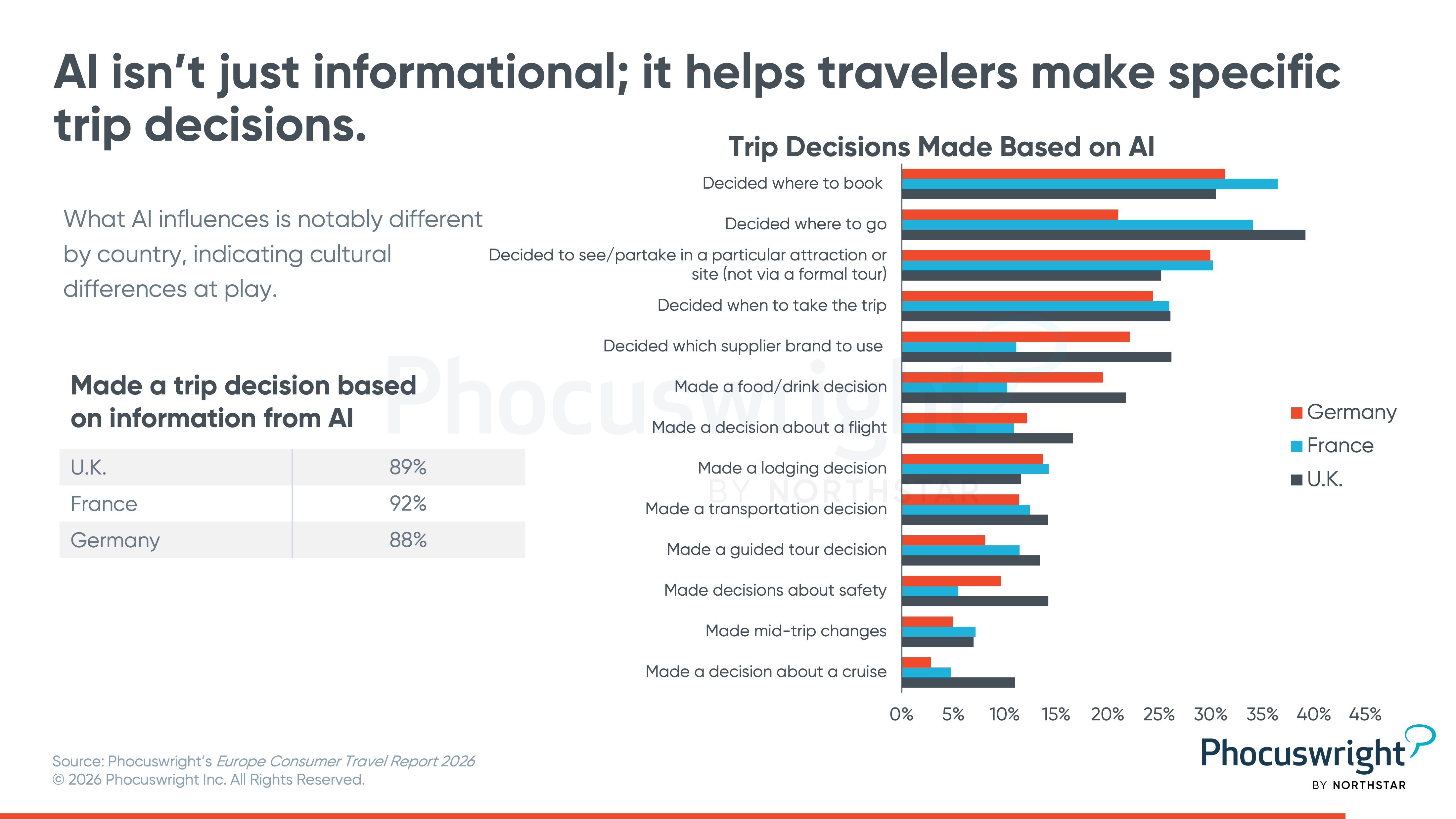
Close to nine in ten AI-using travelers across all three countries say AI shaped an actual trip decision, not just their research, ranging from 88% in Germany to 92% in France. But what gets decided differs in ways that point to real cultural nuance rather than one European pattern. U.K. travelers are notably more likely to say AI shaped where they went and which brand they chose. Booking-platform decisions, on the other hand, skew more heavily toward France.
What this means for marketers
AI influence already touches nearly every stage of the journey. The channels carrying that influence are fragmented and country-specific, so single-channel strategies underperform. And because the decisions AI shapes vary meaningfully by market, a uniform European campaign risks missing real behavioral differences on the ground.
Want more insights? Register to attend Phocuswright’s Travel Marketing AI Summit London, 8 September. Join the industry’s leading marketers and technologists shaping the future of AI in travel. See the program, speakers and register here.
AI is just one factor reshaping how European travelers plan and book. Phocuswright's Europe Consumer Travel Report 2026 covers the rest, including cost sensitivity, digital identity, geopolitical sentiment and what travelers expect to change next. Read the full report.
Curious how these numbers compare across markets, or what the data says about a question this article didn't cover? Phocuswright Open Access subscribers can ask the AI research assistant and get instant, cited answers pulled straight from the full research library. Learn more about Open Access.
The research library that answers back
The Phocuswright AI research assistant gives Open Access subscribers instant, cited answers from the industry's most trusted travel intelligence, across every segment, every region, every report. Open Access subscribers now have a direct conversation with the Phocuswright library.
Ask a question, get a synthesized answer with full source citations, then go deeper.
See the relevant questions and real-life examples of how Open Access subscribers are using the AI research assistant.
More Research Insights