Tours and activities are outgrowing travel overall. Distribution hasn't caught up.
- Published:
- July 2026
- Analyst:
- Phocuswright Research


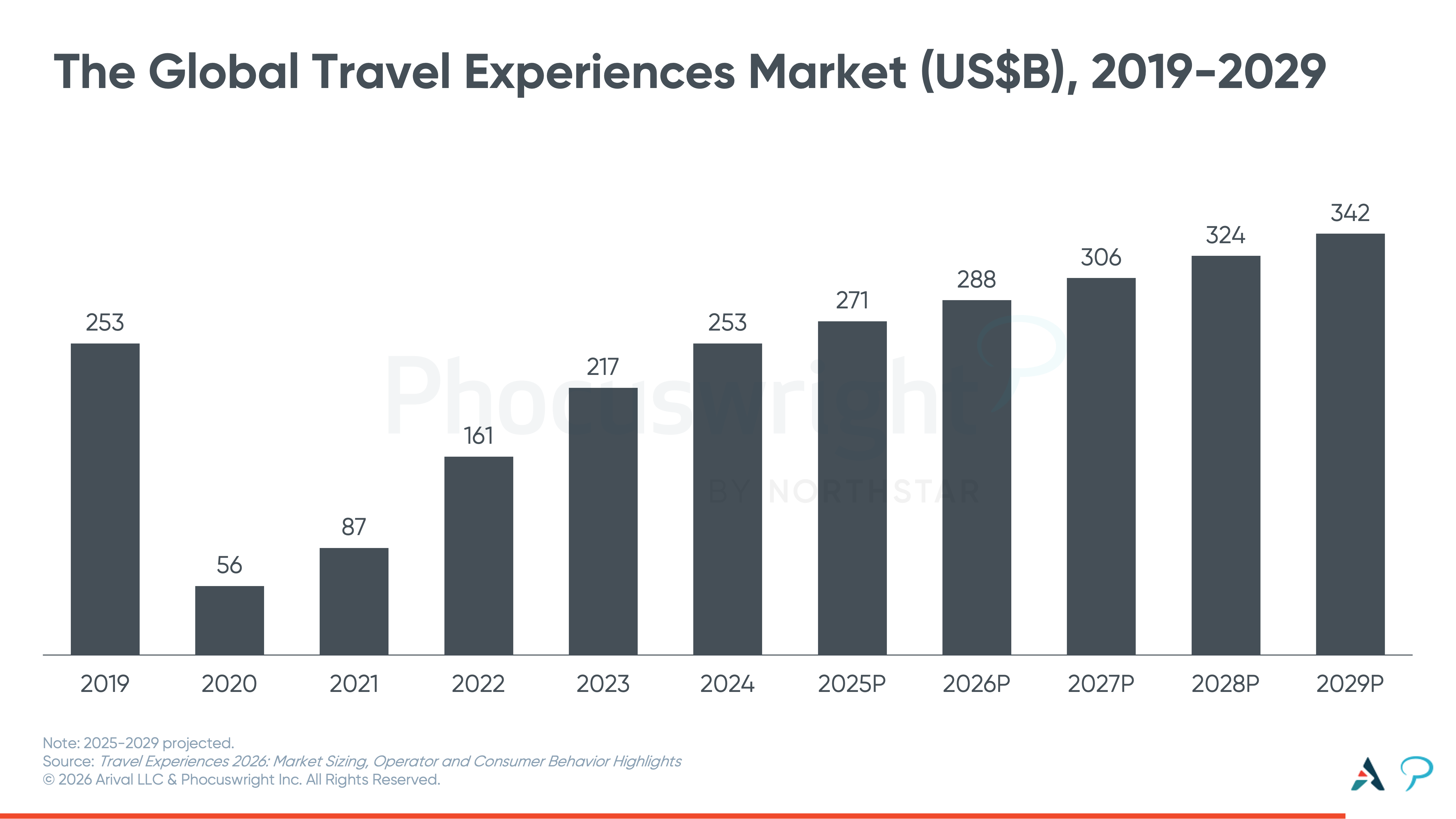
Tours, activities and attractions have moved from a fragmented afterthought to one of travel's fastest-growing segments. A new report from Arival and Phocuswright, Travel Experiences 2026: Market Sizing, Operator and Consumer Behavior Highlights (available for free to everyone), sizes the global market at $253 billion in 2024, a full recovery to pre-pandemic levels, with growth to $342 billion projected by 2029.
The report builds this forecast through a three-step model: mapping supply across 22 major experience categories, estimating revenue using operator survey data from Arival's Global Operator Landscape study (over 5,600 qualified responses), and layering in third-party economic and travel forecasts. Phocuswright's own gross bookings data provides the broader travel market context throughout.
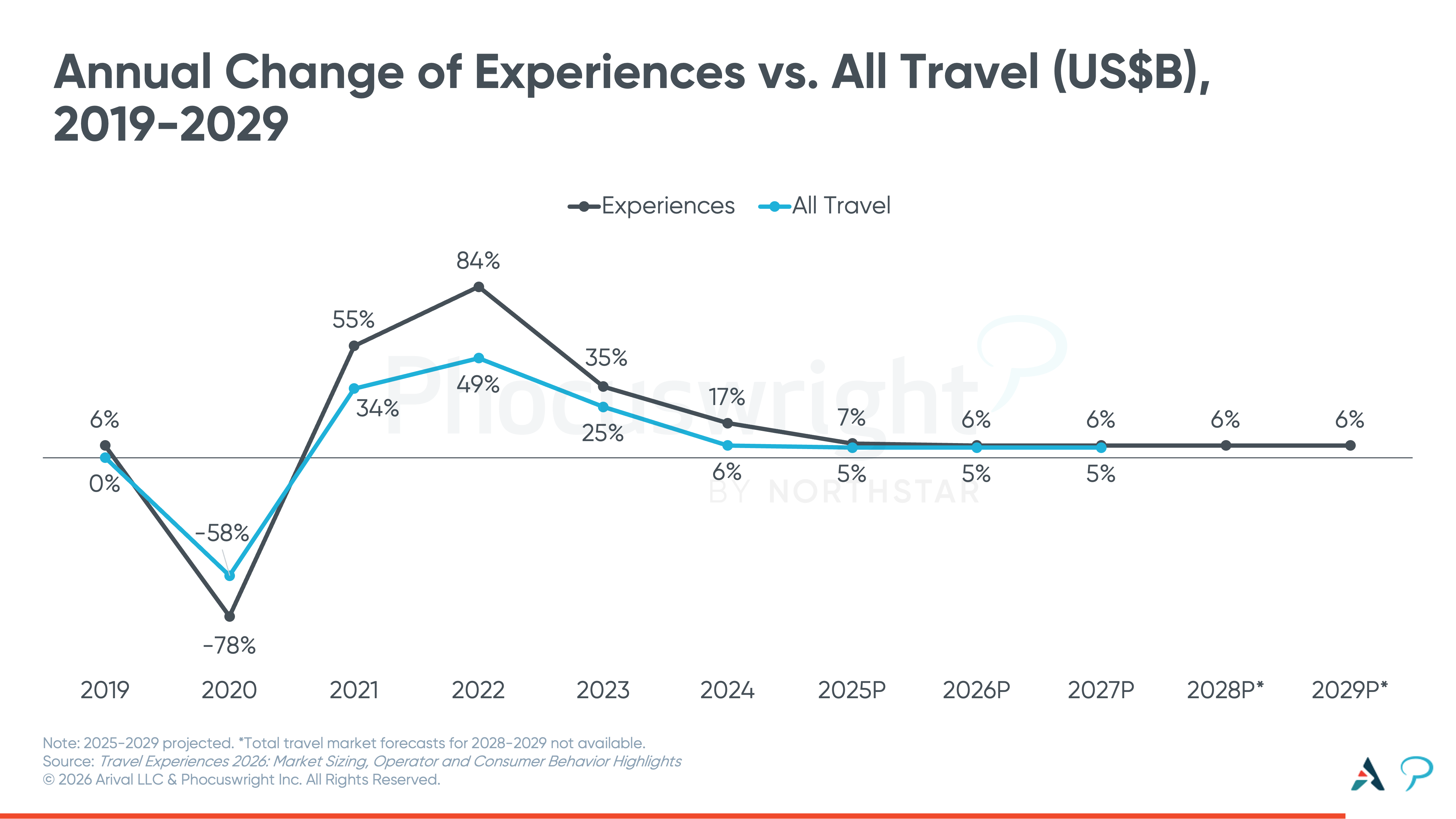
The growth story is stark. Experiences bookings grew 17% in 2024 compared with 6% for travel overall, an acceleration that followed a much harder pandemic-era collapse. Bookings fell 78% in 2020, a steeper drop than travel saw overall, and the sector's rebound since has outpaced the rest of the industry as it caught back up to pre-pandemic levels.
Growth is expected to settle into steadier, more sustainable rates of around 6% annually through 2029, but the report is clear that experiences will keep growing faster than most other travel categories even as the catch-up phase ends.
The growth story is stark. Experiences bookings grew 17% in 2024 compared with 6% for travel overall, an acceleration that followed a much harder pandemic-era collapse. Bookings fell 78% in 2020, a steeper drop than travel saw overall, and the sector's rebound since has outpaced the rest of the industry as it caught back up to pre-pandemic levels. Growth is expected to settle into steadier, more sustainable rates of around 6% annually through 2029, but the report is clear that experiences will keep growing faster than most other travel categories even as the catch-up phase ends.
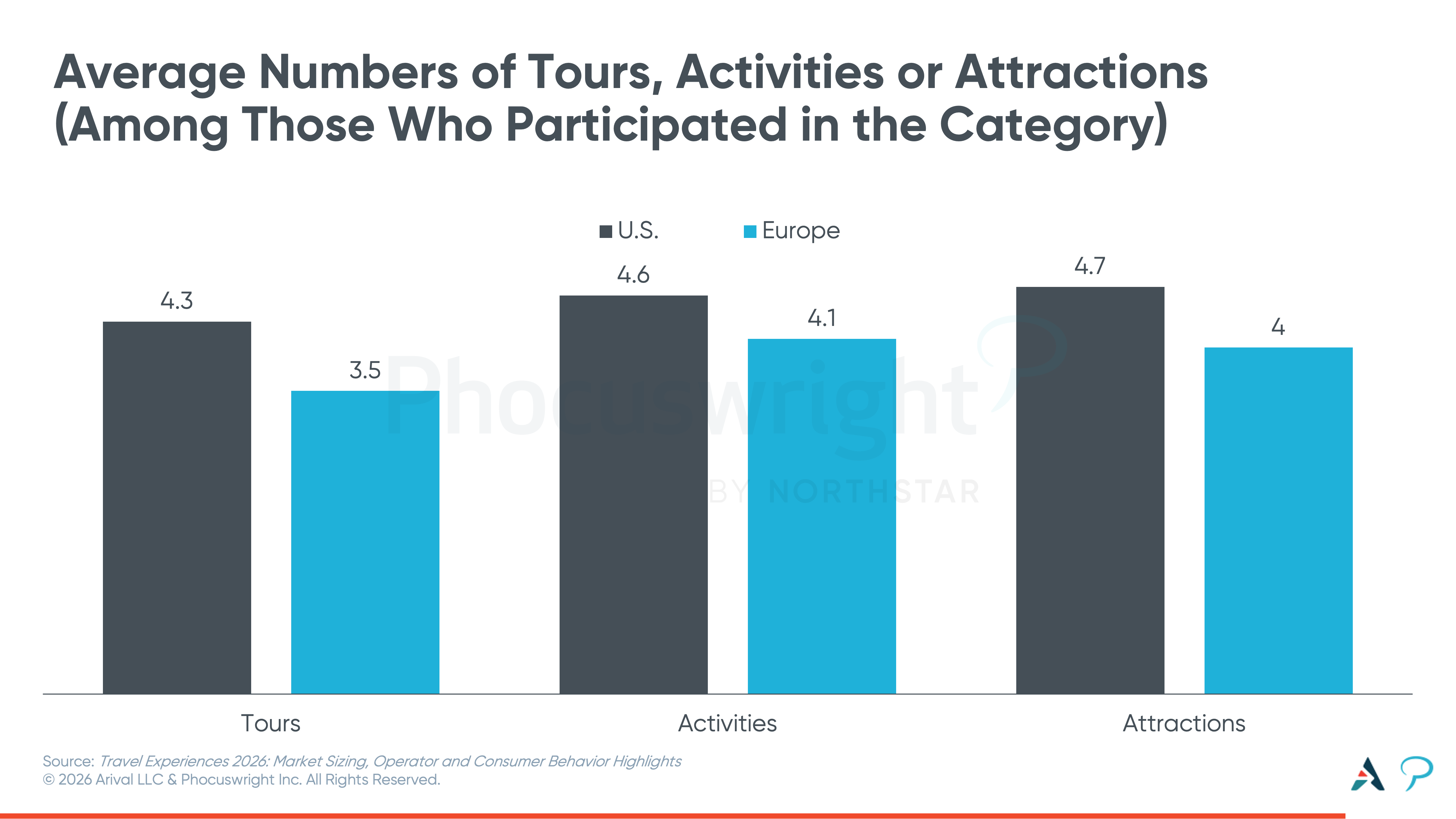
On the consumer side, the report finds that experience bookings are rarely a single purchase. Travelers who booked a tour, activity or attraction did so multiple times per trip on average, ranging from 3.5 to 4.7 bookings depending on category and region. U.S. travelers averaged more experiences per category than Europeans despite shorter average trip lengths (7.1 nights versus 8.3), a gap the report attributes partly to differences in trip pacing and partly to the sheer variety of options available at U.S. destinations.
Spending tells a more complicated story. Per-person spend on tours has held roughly flat in the U.S. over the past three years while activities and attractions spend has ticked up modestly. In Europe, spend across all three categories has softened. The report frames this as travelers prioritizing the number of experiences booked over the amount spent per experience, a sign of budget-consciousness rather than declining interest in the category overall.
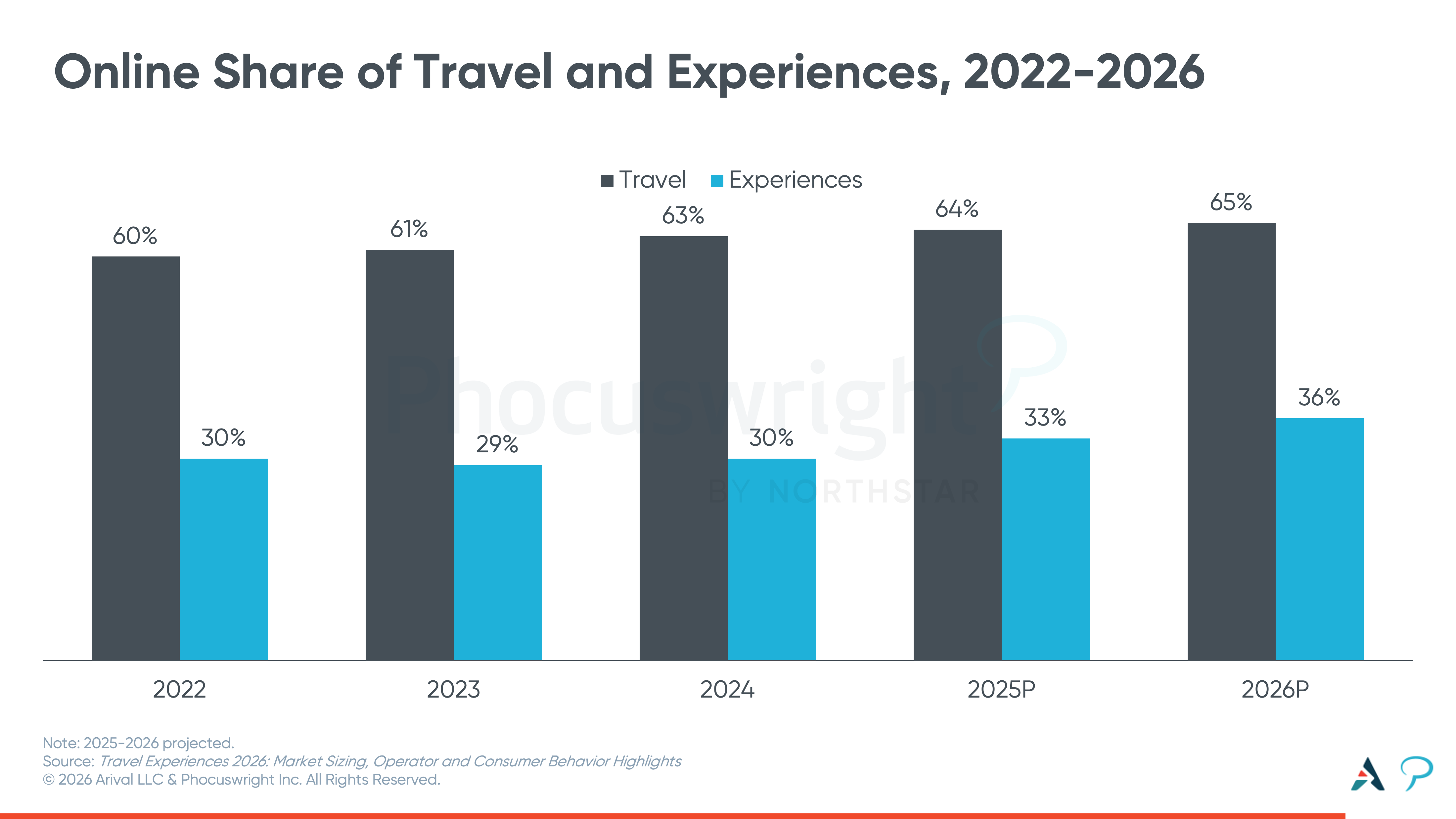
Distribution has grown more slowly here than in the rest of travel. Only 33% of experiences were booked online in 2025, compared with 64% of travel bookings overall, even as specialized marketplaces like Viator and GetYourGuide expand their inventory. The report ties this gap to two forces working together: a fragmented, ultra-local supply base (more than 70% of operators are small or micro-businesses) that has never consolidated the way air, hotel and cruise did, and genuine traveler comfort with offline booking. Nearly 1 in 5 travelers under 55 and 24% of those 55+ booked as a walk-up on their most recent trip, a pattern the report calls unique to the experiences category among travel verticals.
Booking timing varies meaningfully by age and region. Only 12% to 30% of experiences are booked same-day, and older travelers book same-day far more often than younger ones. Across both the U.S. and Europe, the top reasons travelers cite for booking in advance are wanting concrete plans locked in and knowing in advance that they wanted the experience, followed closely by concern that spots might sell out, a factor the report links to capacity limits and overcrowding at popular attractions.
The report closes with a category-by-category breakdown of the most popular experience types. Sightseeing tours top the list in the U.S. at 42%, while cultural sites and landmarks lead in Europe at 47%. Spa and wellness activities are notably more popular among Europeans (33%) than Americans (23%), while Americans show a stronger preference for culinary tours and classes (40%) than their European counterparts (32%). These regional preference gaps, paired with the booking timing and channel data, give operators and marketers a granular view of how demand differs by market.
Get the full data on market sizing, booking channels and traveler behavior by region. Read the report now.
Key questions addressed by this report include:
- How large is the global travel experiences sector, and how is it projected to grow in the coming years?
- How do U.S. and European travelers incorporate tours, activities and attractions into their trips?
- Which types of experiences are most popular in the U.S. and Europe, and what do those patterns reveal about traveler preferences?
- How do booking windows and purchase timing for experiences differ from other travel components such as air and lodging?
- What portion of the experiences sector has moved online, and why do offline and in-person bookings remain so important?
- How do experience booking behaviors differ by age group, region and experience type?
This report is one piece of a much larger picture. Phocuswright Open Access subscribers get the full library of research on every major travel sector, including market sizing, consumer behavior studies and operator surveys across air, hotel, short-term rental, experiences and more.
Subscribers also get direct access to the Phocuswright AI research assistant, built to answer questions across the entire research library in seconds rather than searching report by report. Ask it to compare markets, pull specific data points or surface findings across years of research, all grounded in Phocuswright's own reports. Learn more about leveraging the research assistant.
Subscribe to Open Access to get the full report library and the AI research assistant in one plan.
More Research Insights