13% is the number that explains why OTAs need hotels to keep working
- Published:
- July 2026
- Analyst:
- Phocuswright Research


13%. That is the share of airlines' online passenger revenue that flows through OTAs, according to Phocuswright estimates in the latest report U.S. Online Travel Agency Market Essentials 2026. It is easy to miss inside a report that opens with steadier numbers: U.S. OTA gross bookings rose 4% in 2025 to $100.3 billion, OTAs now represent one fifth of all U.S. travel gross bookings, and that share is projected to reach 21% by 2028. Read at that level, the OTA model looks intact.
The segment breakdown tells a different story for air specifically. Air's share of OTA gross bookings has declined to 20%, driven by travelers migrating to airline websites and apps and by airlines using tighter capacity and higher fares to reduce the incentive to shop elsewhere. Only 13% of what airlines earn online passes through an OTA at all. Airlines have kept the online air customer largely for themselves.
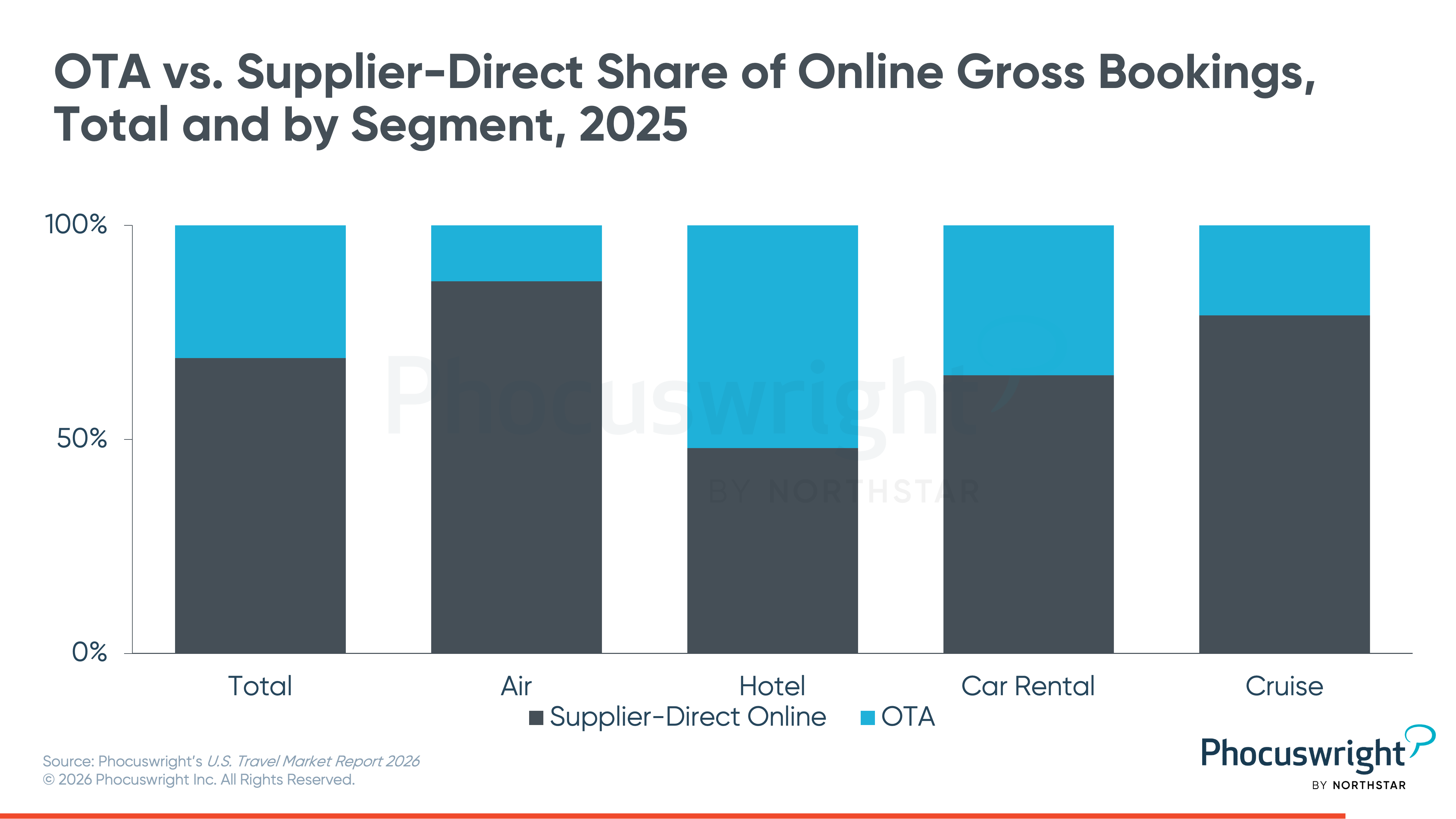
Hotels are the segment doing the work the industry narrative credits to OTAs broadly. Hotel bookings represent 63% of OTA gross bookings, and even there growth has slowed as overall U.S. hotel room revenue growth cools. The 4% headline growth rate and the rising 21% share are, in large part, a hotel story wearing an OTA-wide label. Air is not a growth lever for OTAs anymore. It is a segment airlines have mostly closed off.
That concentration is the risk the top-line numbers hide. A hotel slowdown would not be offset by air, because air has already been ceded. It would need to be offset by the segments still growing inside the OTA book, packaged trips, cruises, activities and other supplier categories filed under "other" sales, all smaller and less proven at scale than hotels. The industry's overall growth rate looks stable. What is actually stable is one segment, and this report's own numbers show that segment's growth cooling too.
The 13% figure is one data point inside Phocuswright's U.S. Online Travel Agency Market Essentials 2026, which covers market sizing through 2029, segment-by-segment shares for air, hotel and other categories, and the competitive dynamics shaping Expedia, Booking and the OTAs built around them. The full report also digs into where AI, B2B expansion and packaging investment are having the most impact on growth.
This report is part of the U.S. Travel Market Report 2026 series, which includes matching essentials on airlines, hotels, car rental, cruise and packaged travel, along with the full data sheet for subscribers.
Phocuswright Open Access subscribers can put questions like these directly to the Phocuswright AI research assistant, the tool built to answer them. Ask "What is the current state of agentic AI adoption across the travel industry?" or "Which travel tech verticals are attracting the most venture capital right now?" and get a synthesized, cited answer pulled from the full Phocuswright research library, with report title, publication date and page number attached to every claim. Subscribers can then narrow the scope, switch regions or follow up with another question, and the assistant works across multiple reports in the same exchange. Discover more about it here.
Contact us to learn more about leveraging the AI research assistant.
More Research Insights