U.S. travelers plan to do more next year, and each generation economizes differently
- Published:
- November 2026
- Analyst:
- Phocuswright Research


U.S. travelers expect to travel more in the year ahead, led by younger generations. According to Phocuswright’s Global Traveler Trends 2026, Millennials and Gen Z lead on every measure of intent, from trip volume to budget to trip class.
The data also shows how each generation would cut back when money is tight, and how far interest in buy now, pay later runs ahead of actual use.
Travel intent
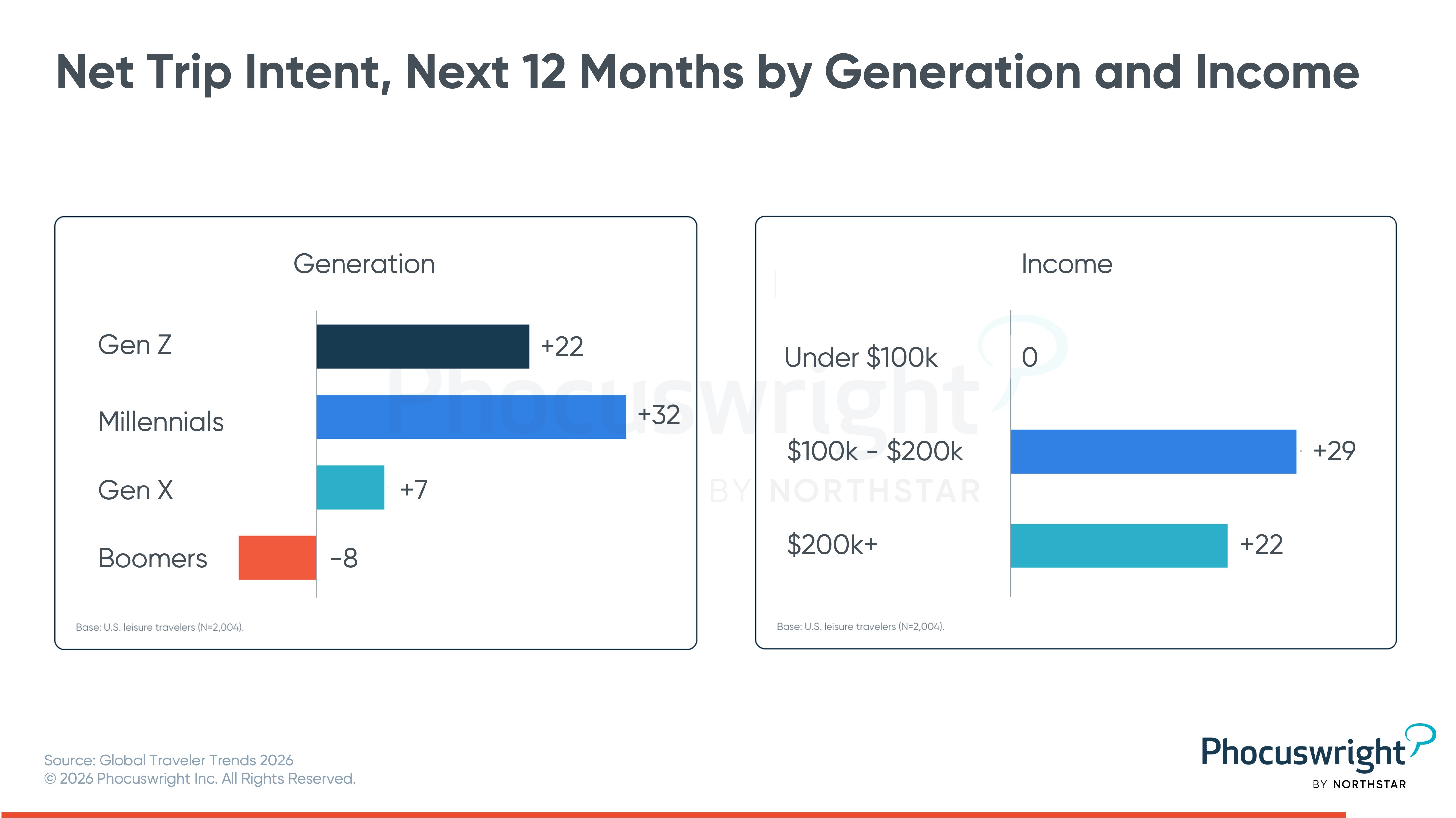
Millennials post the strongest net intent to take more trips. Gen Z leads on bigger budgets and higher overall trip class. Both groups plan more air travel, more international trips and longer stays.
Income draws a similar line. Travelers earning under $100K expect no change in trip volume. Those earning $100K to $200K are the most bullish group in the survey, ahead of the $200K+ segment. Baby boomers are the only generation planning fewer trips on net.
Cutting back
Under economic stress, baby boomers are the most likely to drop trips altogether. Younger travelers keep the trip and trade down on its parts. Gen Z would fly a lower cabin class or skip paid seat selection. Millennials would accept longer flights or use more public transit. Gen X looks for savings at the destination, in activities and dining.
Boomers also sit at the other end. They are the most likely of any generation to change nothing. Across all travelers, shifting to the off-season ranks among the most common levers.
Paying over time
Four in 10 U.S. travelers say they would travel more if buy now, pay later were offered, and interest peaks among Millennials. Actual use runs far lower. Phocuswright notes that these figures measure stated intent, but the gap marks a sizable audience that has not yet converted.
Use is highest for short-term rentals and car rentals. Baby boomers barely use BNPL for any trip component.
Get the full picture with Open Access
This article covers one tab of Global Traveler Trends 2026. The full report includes net intent across 10 trip dimensions by generation, cutback behavior by age and income, BNPL use by trip component and the reasons non-travelers stayed home. Other tabs cover AI adoption among U.S. travelers, Japan, European payment and loyalty and Latin American experiences.
Open Access subscribers get every report in the Phocuswright library plus Phocuswright’s AI research assistant. Ask how BNPL appetite in the U.S. compares with the U.K. and Germany or which generations plan to upgrade lodging next year. It answers in plain language with data from Phocuswright’s full body of research, in seconds. Use it to shape a pricing strategy or build the case for a new payment option before budget season.
More Research Insights