
Under the Influence: Social Media’s Role in Trip Planning and Inspiration


Travel is alive and buzzing in the ecosystem of social media. Users, brands and influencers alike are piping in across platforms to share, guide and inspire across all touchpoints of the trip experience. But while the conversation is vibrant, the social media sphere is continuously transforming, and travelers on social platforms often diverge from some of the patterns observed when people engage with content associated with other industries, such as fashion or retail.
This article is derived from the findings of Phocuswright’s U.S. Consumer Travel 2022 survey and explores the demographics of who is using social for travel, what platforms they’re on, and the role of social in their travel practices. With a plethora of travel users, providers, distributors and influencers at the table, Phocuswright’s primary travel research highlights opportunities to optimize social strategy to better speak to the needs, habits and budgets of travelers on social.
Social’s role in trip planning


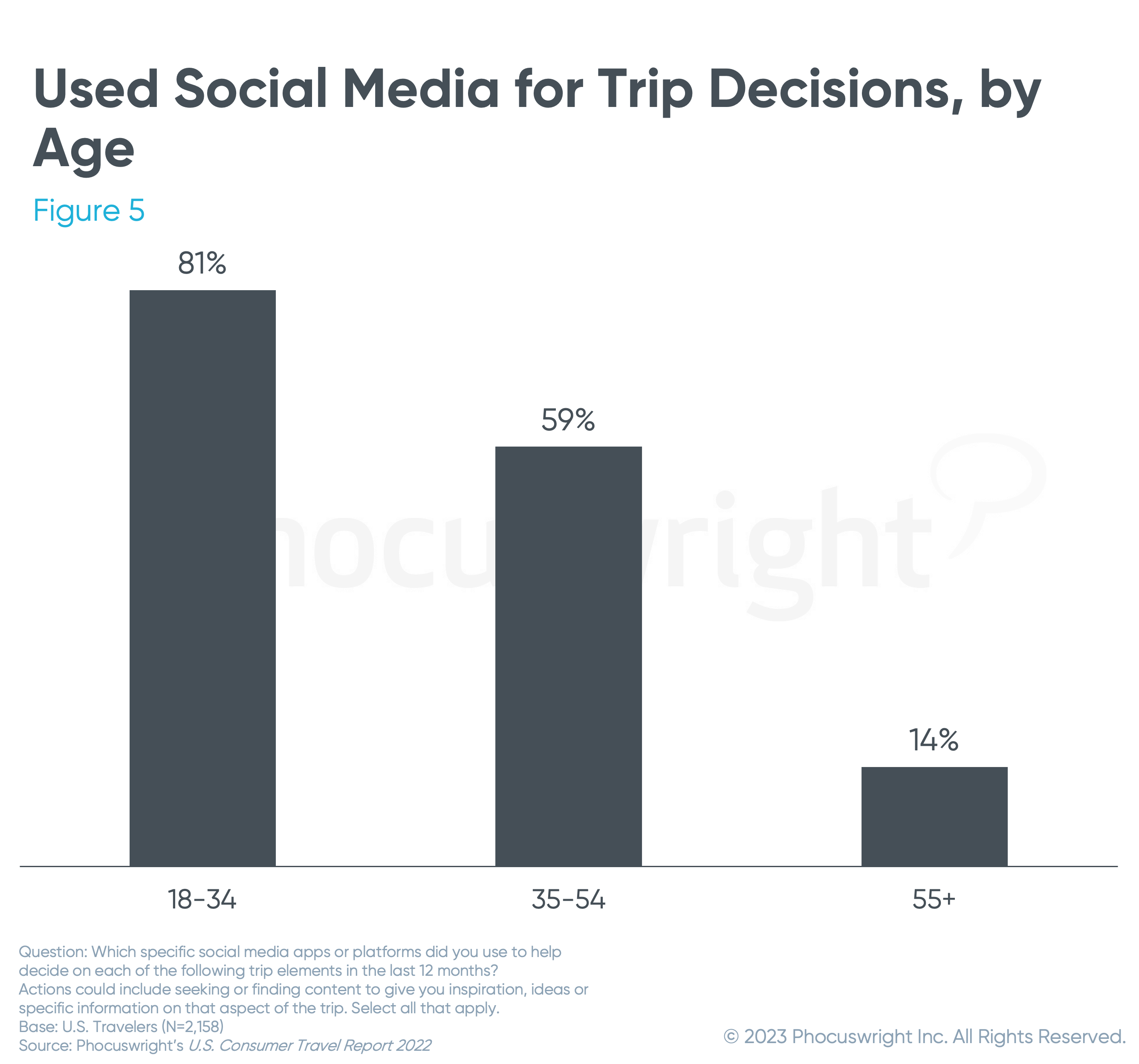
With its visual formats and personal touches, social media content plays a significant role as travelers figure out where to go and what to do on their trips. More than half of all leisure travelers used a social media platform to aid at least some of their trip-related decisions. Travelers who are younger than 35 are particularly likely to use social media, with 81% saying they used it, compared to only 14% of those 55 and older.
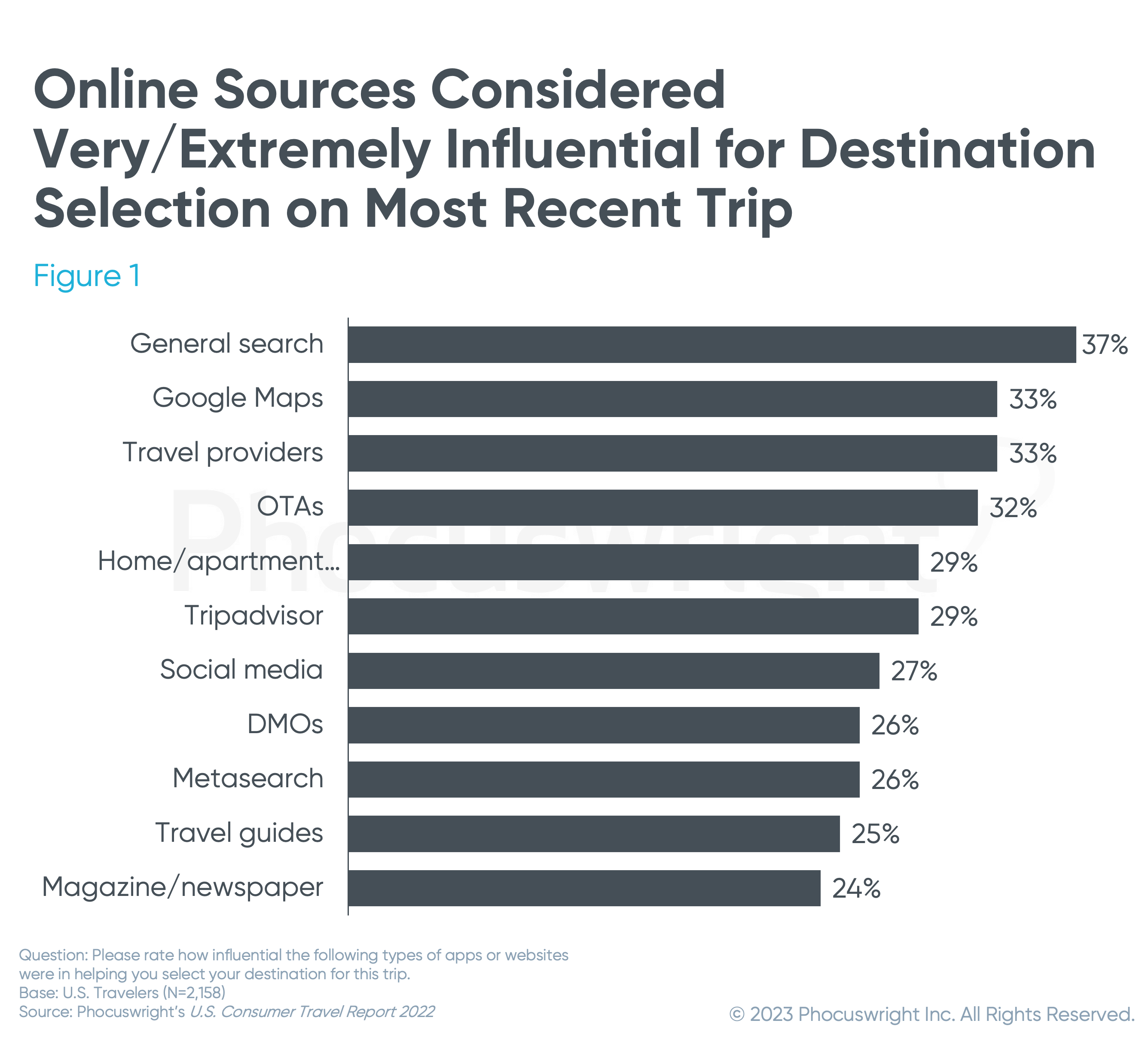
While social can be helpful in passive information collection, it is not typically the go-to for the active research process, where general search emerges as a prominent resource. Twenty-seven percent of travelers said social media was very or extremely influential when they were choosing a destination for their most recent trip, compared to 37% for general search (see Figure 1). Social remains influential in destination selection for more than one fourth of travelers (and 46% of those 18-34) but exists among a large set of sources that travelers consult in the decision-making phase. General search may hold the power to be more consultative than social media when travelers can tailor specific questions and search prompts to their needs.

For information collection about other parts of the trip, social holds an important place in the process of building leisure itineraries. But beyond destination selection, general search still remains king of the funnel. Forty-six percent of travelers used it for researching in-destination activities (see Figure 2). Social networks, despite their popularity, did not even occupy a spot in the top five for the overall traveling population, and were the fourth most utilized activity research platform for those under 35.



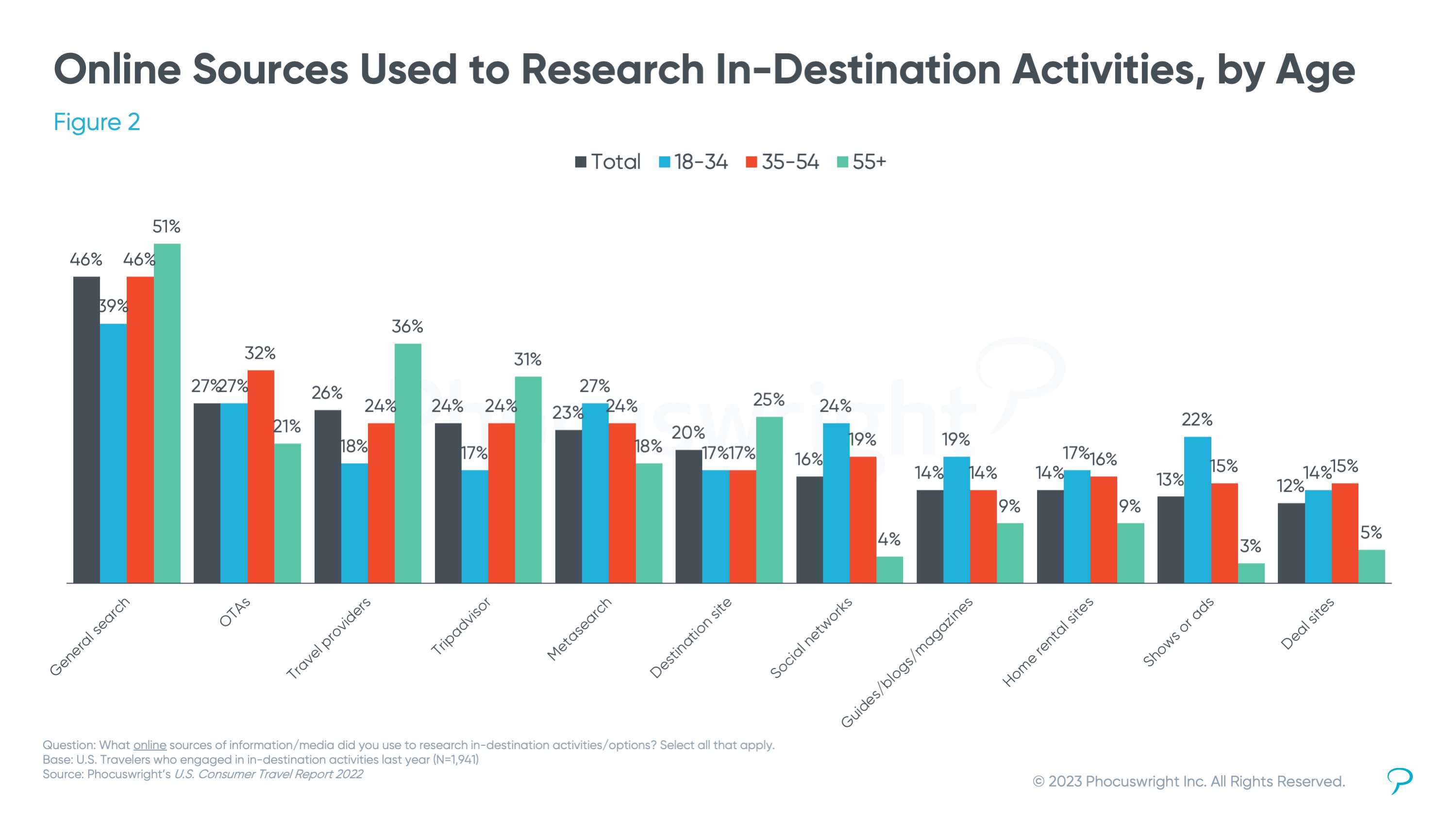
Based on demographic usage, there were some indications that general search use could decline over time. Travelers 55 and older are the heaviest users of general search, and lightest users of social media. As Gen Z becomes a more prominent demographic in the U.S. traveling population, this group’s propensity to rely on social media may lead to increased reliance on social networks in the active research process. However, travelers under 35 still used general search at higher rates than any other online resource in both destination and tour/activity selection.
With conversational AI rapidly entering the mainstream, general search will evolve rapidly to accommodate these new developments. Microsoft’s Bing search engine has already introduced AI-powered chat functionality. Online travel agencies (OTAs) like Trip.com and Expedia have added plug-ins and/or incorporated conversational AI into their own apps in a bid to reduce friction during travel planning and booking.
Long game for destinations, short game for components

A vital distinction between social marketing in travel and traditional retail products is that travel decisions, especially destination selection, are seldom impulsive. Consumers want to feel confident and informed regarding their decisions, given that leisure travel is relatively infrequent and can be fairly costly. With respect to marketing interactions, this may mean multiple exposures are required before conversion, or lengthy conversion periods following exposure to ads or promotions.
Destination Selection: For the majority of travelers, information gathering and comparison of destinations – whether active or passive – happens before trip planning officially begins. Sixty-three percent of travelers had a specific destination in mind and did not look into other options for their most recent leisure trip. An additional 30% of travelers begin trip planning with a shortlist of destinations already in mind. For destination marketers, social strategy needs to play the long game. Though 52% of travelers used a social platform for destination selection and 27% considered social media very or extremely helpful in choosing where to go, marketers must account for the fact that impactful exposure to social marketing may occur months or even years before travelers take concrete steps to book transport and lodging.
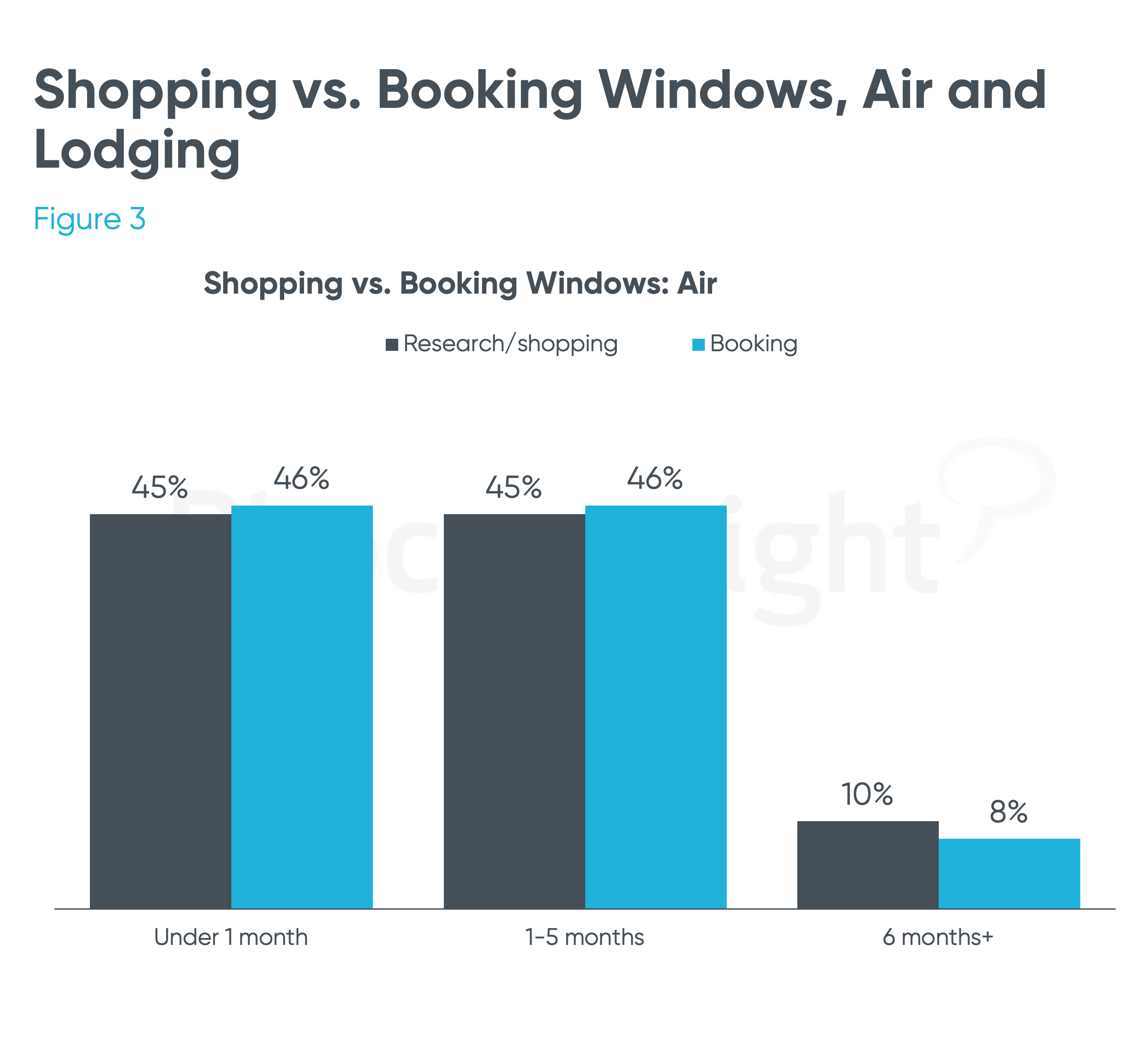
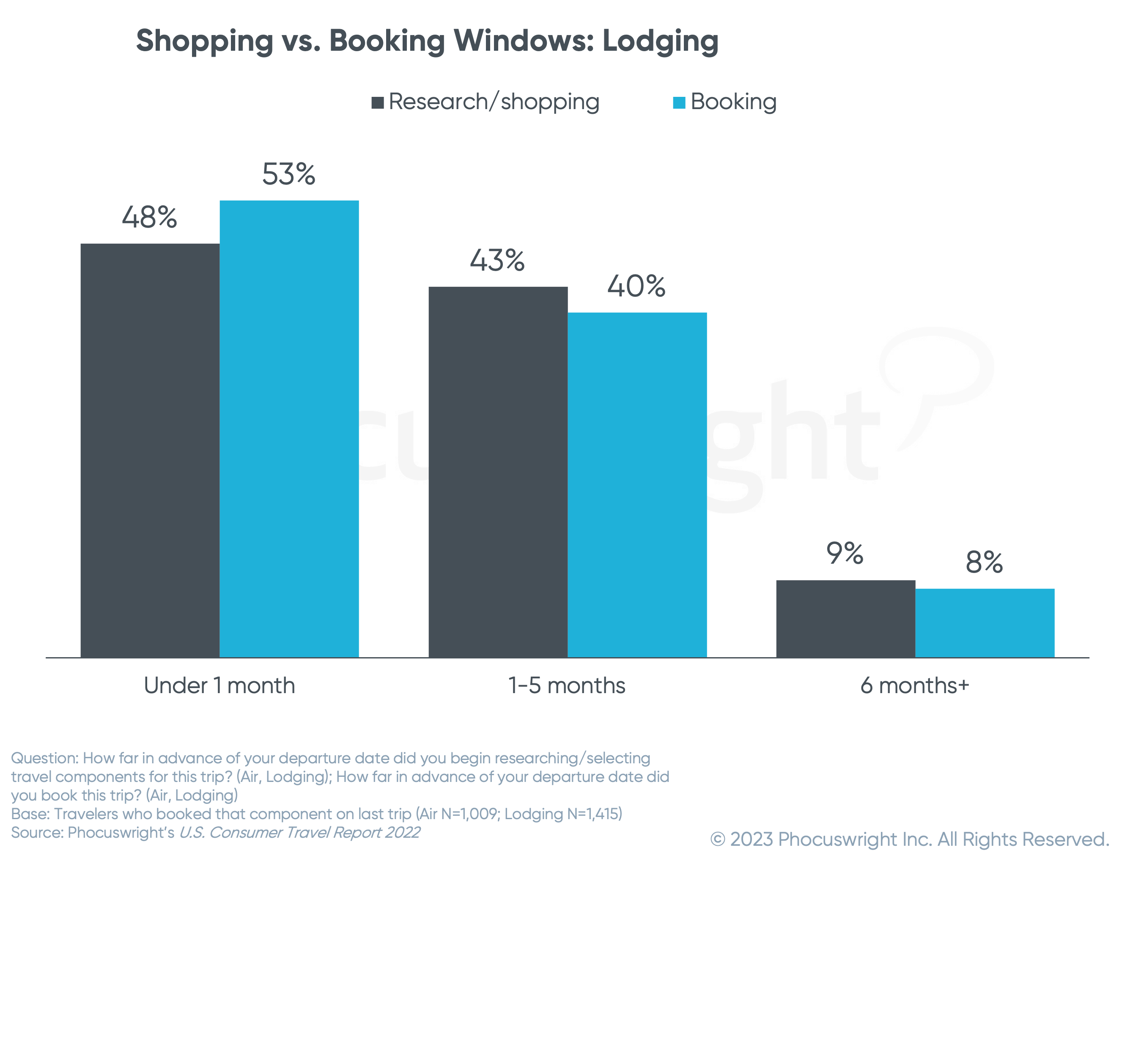
Components: Destination selection can last for an extended period, but the windows for research and booking for air and lodging closely mirror each other – meaning travelers do not typically have a prolonged period between shopping and the final booking decision (see Figure 3). Forty-seven percent of travelers referenced social media for flights, and 48% did so for accommodations. This leaves a narrow window when socially engaged travelers can be effectively targetable for relevant information or promotions related to air and lodging, compared to destination decisions.


Platform usage

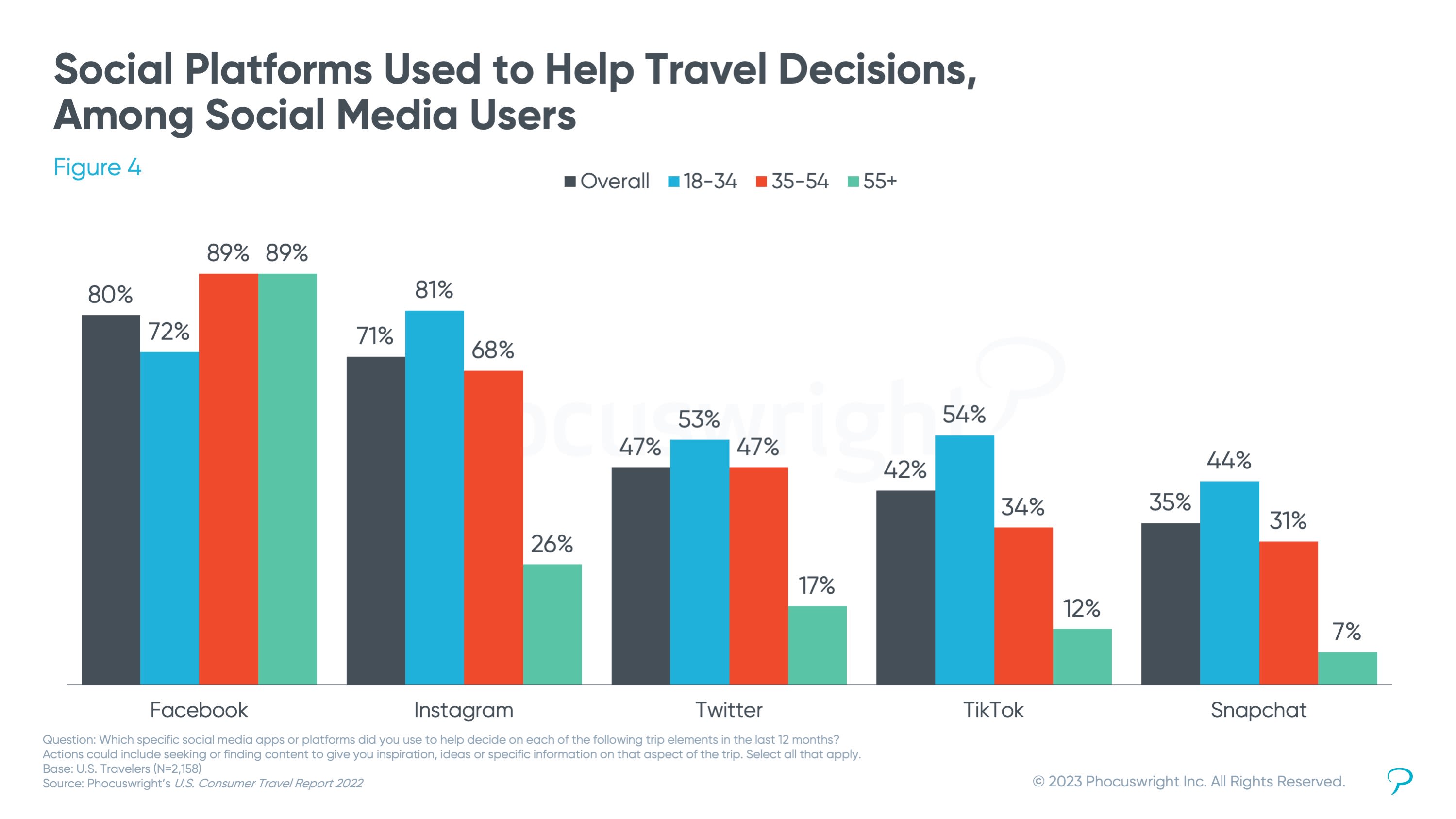
When it comes to specific platforms consulted for travel decisions, Facebook is the overall leader. Four in five travelers who use social media for travel decisions favored content or information from Facebook. Notably, that utilization is heavier for travelers 35 and older. And while travelers 55+ display less comfort and literacy navigating social networks on the whole, if they do employ social media for travel decisions, it’s far more likely to be Facebook than any other platform. Eighty-nine percent of travelers 55+ on social media used Facebook (see Figure 4). For those under 35, Instagram rises to higher prominence and is the most-utilized platform.
Facebook and Instagram are the significant platform leaders in the space, with a sizeable drop-off in usage incidence between these two and Twitter, the third most-used platform. Fewer than half (47%) of those who used social for travel planning did so on Twitter, compared to 80% and 71% who used Facebook and Instagram, respectively.
A multi-platform approach is the norm for travelers who utilize social media. On average, they use 2.8 platforms, flipping between different sites and apps to inform and inspire their trips.
Aging out

Traditionally, social networks have been considered a young person’s tool. Younger consumers tend to be more digitally savvy, more comfortable navigating social resources, and heavier users of platforms overall.
This is not a myth that needs debunking, per se. Today’s younger “digital natives” use social media more often for trip decisions and use more social platforms for these decisions than their older counterparts, particularly those 55 and up. While travelers under 35 rely on social more, it would be misleading for marketers and brands to overlook social usage for travelers ages 35-54. Myspace was launched 20 years ago in 2003, and Facebook was not far behind, launching in 2004. Some early social media users (notably older millennials) have had versions of social tools at their disposal for two decades; gone are the days when social media is a foreign concept to middle-aged travelers.
Today, most travelers 35-54 (59%) use social media for trip decisions (see Figure 5) and leverage 2.7 platforms on average. They use it widely across various areas of inspiration – from destination selection to activities to transport and lodging. Their preferred platforms differ from their younger counterparts’ favorites, but as a group, they remain present and active.

This dynamic still suffers from some lingering disconnect between audiences, brands and marketers. Social marketing and influencer partnerships frequently feature young people in their 20s and early 30s, which may not accurately reflect the demographics of their followers. Lack of representation may hinder engagement or conversion for social marketing efforts among travelers 35-54.

Under the influence

Conversations on social and influencer marketing go hand in hand. Influencers have become a fixture of the modern social media presence, and partnering brands latch onto them for access to their followers and content expertise. The fashion industry in particular has enjoyed remarkable success from their work with influencers; leading platform LTK yields $3.6 billion in annual sales in the fashion space.
But travel marketing is a horse of a different color, and there are essential distinctions to draw between the way consumers engage and convert with travel content compared with influencer content pertaining to other industries. Across all traveler age groups, the most common types of accounts used for inspiration – by a significant margin – come from family and friends (55%) (see Figure 6). Travelers turn to personal contacts who they know and trust for direction, inspiration or advice.

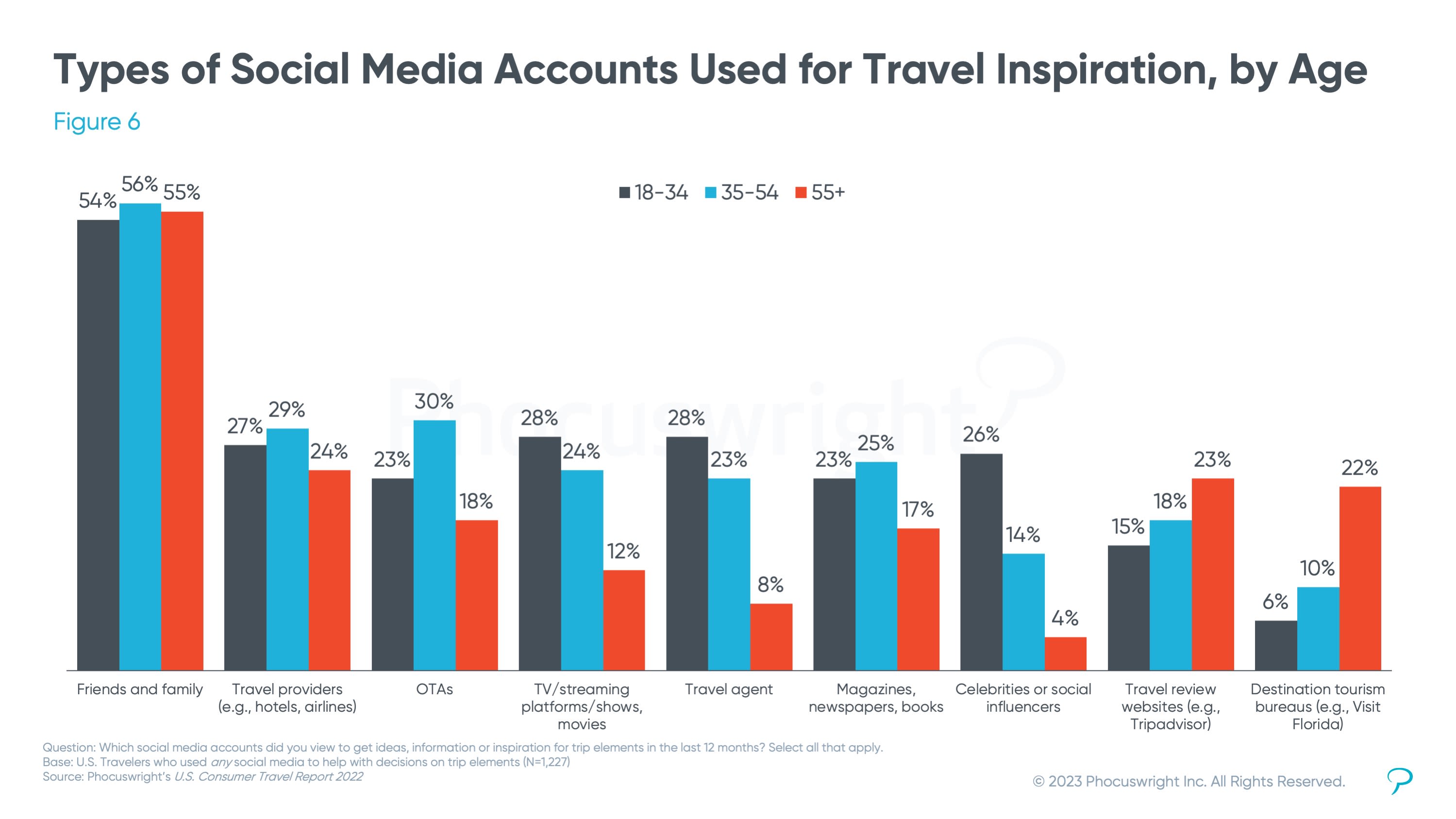
But beyond the social accounts of family and friends, travelers are more likely to reference a string of other account types before they turn to celebrities or influencers. Travel providers, OTAs, agents, TV and print media accounts are all referenced at a higher frequency than those of celebrities or social influencers, which are only utilized by 18% of travelers on social.
Though they are not the most commonly used by any stretch, celebrity or influencer accounts can be valuable in their reach. Influencers capture the attention of followers who express an avid interest in their travel and content styles, and who often look to them as advisers and tastemakers.
One of the segments most likely to leverage influencer content is frequent travelers. Thirty-two percent of travelers who took six or more annual leisure trips reported using influencer accounts, compared to 20% of those who took 3-5 trips and 15% of those who took just 1-2 trips. Heavy travelers may gravitate toward them for convenient inspiration. Furthermore, they may be more open to suggestions because they have time and availability to take multiple leisure trips, or they trust themselves more to discern quality advice from influencer accounts.
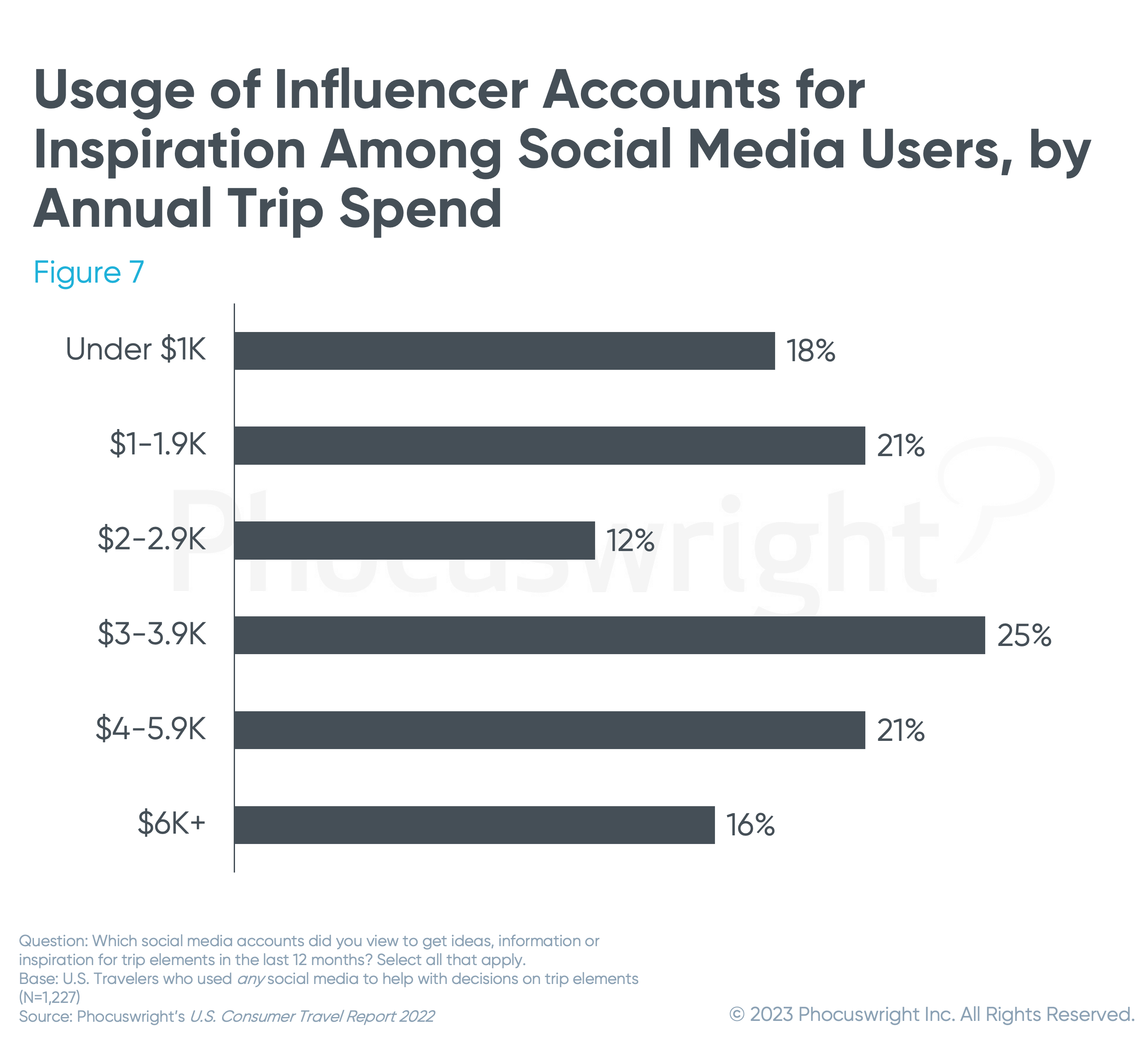
Despite the advantages of influencer reach for brands and marketers, their followers do not necessarily capture the demographic of high spenders. Influencer content consumption does not show a strong correlation with annual spend activity; travelers who spend $6,000 or more per year on their leisure trips are no more likely to look to influencers than those who spend less than $1,000 annually (see Figure 7). While brands and marketers may choose to partner with content creators in part to push the aspirational or inspirational elements of travel, companies should also consider how their offerings fit with influencers’ social personas and the profile of their follower base. Many of those who engage with travel social content cannot make luxury travel purchases, but could be inclined toward other mid-tier or budget offers that more closely match their habits and budgets.


Tapping the opportunity

The majority of American travelers engage with social content to research their trips and inform their travel decisions, whether passively or actively. But on the back end, brands and marketers must tap into the audience demographics and the distinct social patterns that are unique to travel. With many successes in travel content engagement and conversion already in the books, there is enormous potential to optimize future content strategy to adapt to the evolving demographics, spending abilities and decision timelines of today’s travelers.
 Built with Shorthand